Antimicrobial Toilet Cubicles
Antibacterial Sanitized® ActiFresh
Sanitized® ActiFresh
The Sanitized® ActiFresh treatment is designed to reduce the presence of bacteria on the surface of the cubicle panels. These antibacterial properties alongside its easy cleaning help prevent the spread of bacteria and other harmful microbes.
Available in a range of delicate patterns combined with aquatic shades. These create bright spaces with a sense of serenity and optimism, well suited to healthcare environments.
Safe and hygienic products
Polyrey cubicles feature a non-porous surface that resists chemical agents, making them well suited to hygiene-sensitive environments such as hospitals and commercial washrooms.
Advanced Specifications
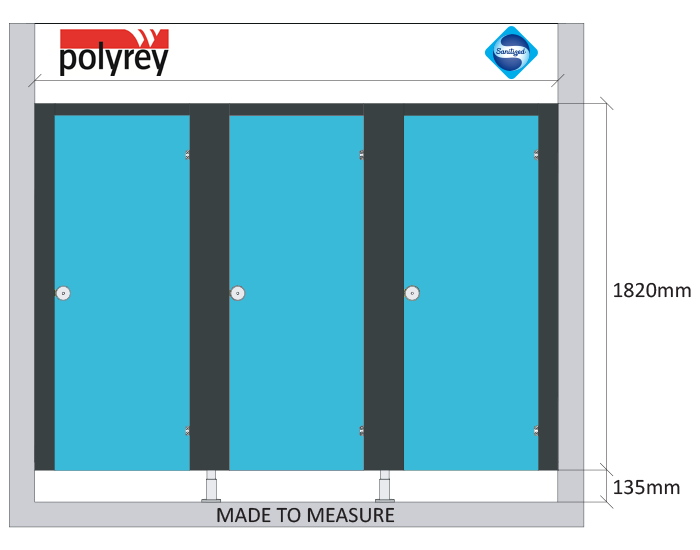
| Door Specs: | 1950mm height from finished floor, with 150mm ground clearance for easy cleaning |
| Core Material: | 13mm Polyrey Compact Grade Laminate – anti-bacterial and moisture-resistant |
| Edge Treatment: | Precision CNC-edged, radiused & polished with black ABS trims |
| Environment: | Designed for humid, high-traffic public washrooms |
| Fittings: | Heavy-duty black powder-coated aluminum with concealed fixings |
Colours & Finishes
Antimicrobial toilet cubicles are available in the same range of colours and finishes as our standard cubicle systems. Preview options on the Mirage, Volante and Rainbow colour pickers, or contact us to discuss the right finish for your project.
Standard Dimensions
How the antibacterial surface works
The panel matters as much as the treatment
Where antimicrobial cubicles are specified
What we check before quoting an antimicrobial specification
- Environment. Wet, humid or dry? Wet and humid areas point to compact laminate regardless of whether the antibacterial finish is added.
- Cleaning regime. How often, and with what chemicals? This governs the material choice more than anything else.
- Traffic and use. Public, staff-only, or a mix; and whether the washroom sees peak loading such as class changeover or visiting hours.
- Accessibility. Doc M provision, outward-opening doors, ironmongery, and colour contrast between adjacent surfaces.
- Dimensions and layout. Room drawings, cubicle quantities, ceiling heights, floor clearance and any project-specific dimensional or access constraints.
- Coordination. Whether IPS duct panels, vanity units and cubicle fittings need to match the cubicle finish.
- Finish. Colour selection confirmed against physical samples rather than on-screen previews.
Antimicrobial toilet cubicles – frequently asked questions
What makes a toilet cubicle antimicrobial?
A silver-based antibacterial additive is incorporated into the decorative surface of the laminate during manufacture. Ambient humidity releases silver ions, which disrupt the metabolism of bacteria on the surface and limit their ability to multiply between cleans. It is part of the panel, not a coating applied to it.
Does an antimicrobial cubicle replace cleaning?
No. The finish is designed to complement a cleaning and disinfection regime, not to substitute for one. Washrooms should continue to be cleaned to the operator’s normal standard and schedule.
Does the antibacterial protection wear off over time?
The additive is distributed through the surface layer rather than sitting on top of it, so normal cleaning and everyday wear do not remove it. The manufacturer states that protection is retained for the life of the panel and that the finish is resistant to standard disinfectants and care products.
Has the finish been independently tested?
Polyrey tests to JIS Z 2801:2010, the recognised method for measuring antibacterial activity on non-porous surfaces, and reports a 99.9% reduction over a 24-hour test period across seven bacterial strains including E. coli, Pseudomonas aeruginosa, Klebsiella pneumoniae, Salmonella enteritidis, Listeria monocytogenes, Staphylococcus aureus and MRSA. Those are laboratory test results against bacteria; they are not a claim about viruses or fungi.
Which environments are antimicrobial toilet cubicles used in?
Most commonly hospitals, clinics, GP and dental surgeries, care homes, schools and colleges, leisure centres, swimming pools, changing rooms and food-service washrooms. In short, anywhere hygiene is formally managed and cleaning is frequent.
Can I have the same colours as your standard cubicles?
The antimicrobial range shares the colour and finish options of our standard cubicle systems. You can preview options on the Mirage, Volante and Rainbow colour pickers. On-screen colours are a guide only, so request physical samples before confirming an order.
Do you install the cubicles?
No. Total Cubicle Solutions is supply only. We manufacture and supply cubicles, IPS panels, vanity units and fittings to your specification; installation is arranged by your own contractor.
What information do you need to prepare a quotation?
Room drawings or dimensions, cubicle quantities, preferred colours and fitting finish, the site location and your required delivery date. Tell us the cleaning regime and whether the area is wet or dry, and we will confirm whether the antimicrobial specification is the right choice for the project.