Compliance guide
Approved Document T Explained: Toilet Accommodation in England
Approved Document T is the official England guidance that supports Part T of the Building Regulations for toilet accommodation in buildings other than dwellings. It covers the design and layout of universal toilets, ambulant toilets and toilet cubicles, but it does not apply to schools and it does not set the number of toilets required.
At a glance
| Applies in England to buildings other than dwellings. |
| Covers universal toilets, ambulant toilets and single-sex cubicles. |
| Does not apply to schools or early years provision. |
| Does not set toilet numbers; that question sits elsewhere. |
What is Approved Document T?
Approved Document T is statutory guidance for toilet accommodation in England. GOV.UK describes it as technical guidance on the design and layout of universal toilets, ambulant toilets and toilet cubicles required under Part T of the Building Regulations.
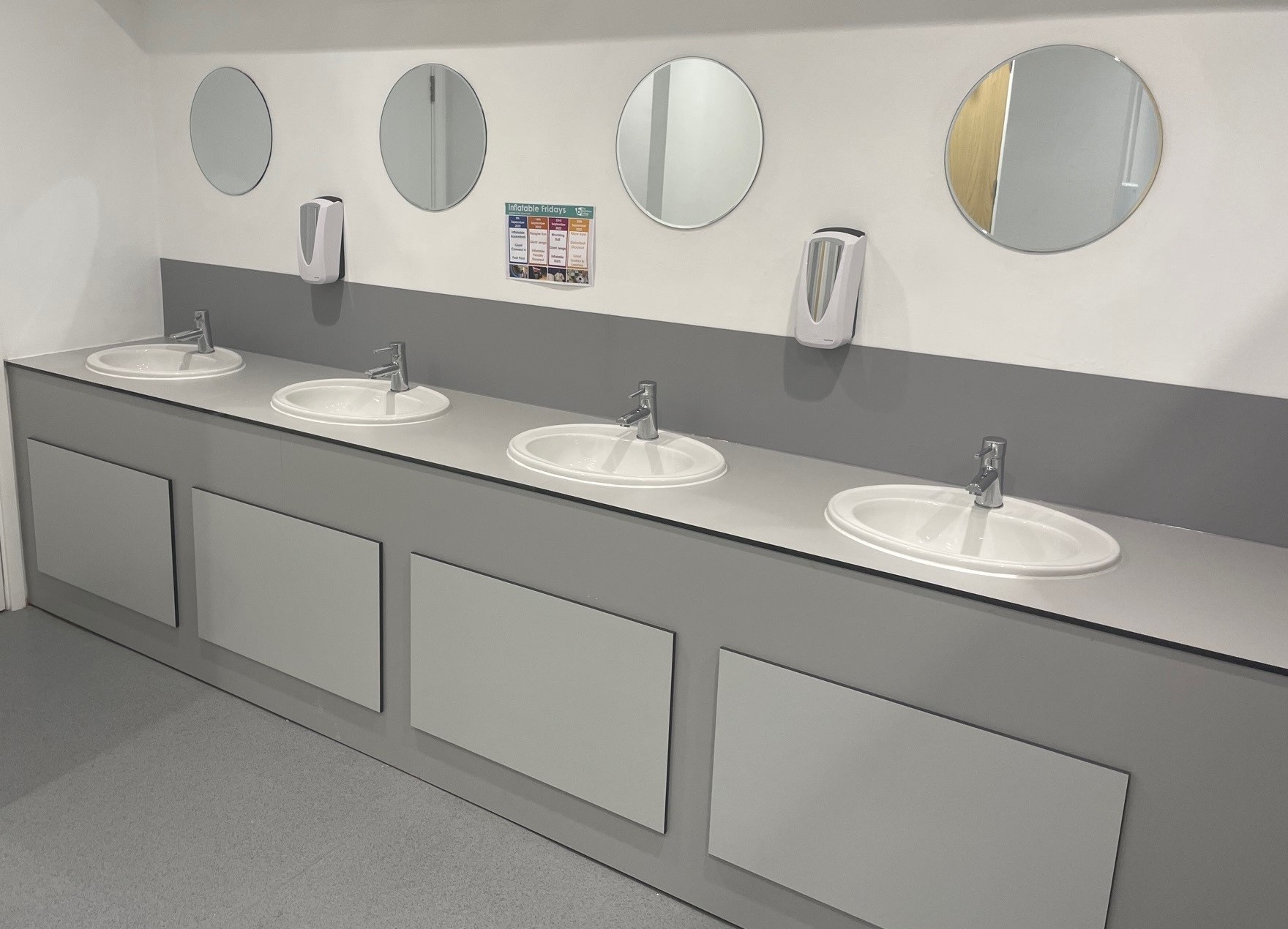
In many commercial washroom designs, universal toilets and single-sex cubicles are specified alongside coordinated IPS panels and washroom vanity units to create a clean visual finish.
The current downloadable government PDF states that it supports Part T of Schedule 1 to the Building Regulations 2010, takes effect for use in England from 1 October 2024, and applies to buildings other than dwellings. The version currently published on GOV.UK was revised in 2025 to correct minor errors without changing policy intent.
Practical takeaway: this document matters whenever a buyer, architect or contractor needs to understand how toilet accommodation should be arranged, sized and described for an England project – particularly for universal toilets, ambulant toilet provision and single-sex cubicles.
The four toilet types in Approved Document T
The guidance identifies four types of toilet accommodation suitable for meeting requirement T1.
Type A
Fully enclosed self-contained ambulant universal toilet.
Type B
Fully enclosed self-contained universal toilet.
Type C
Ambulant single-sex toilet cubicle (not self-contained).
Type D
Single-sex toilet cubicle (not self-contained).
The same section also explains that a universal toilet is available for everyone to use and is not considered a single-sex toilet for single-sex use only.
What Approved Document T does not cover
This is where many supplier pages become confusing. Approved Document T says that Part T does not cover the number of toilets or access to and use of toilets. For workplace provision levels, it points readers toward HSE welfare guidance and to the wider framework of sanitary provision.
That means three different questions need answering separately:
1. Arrangement and type of toilet accommodation — mainly Approved Document T.
2. Accessible sanitary accommodation — mainly Approved Document M.
3. How many toilets are needed — workplace/HSE and other sector-specific guidance.
Where it applies and where it does not
- Section 1 of the approved document says the guidance applies to buildings other than dwellings. It also states clearly that requirement T1 does not apply to schools, premises used for early years provision, cellular accommodation in custodial facilities, or en-suite toilets provided in individual rooms for residential purposes such as hotels and care homes.
- For educational buildings, the same section points readers instead to the School Premises (England) Regulations 2012 for maintained schools and the Education (Independent School Standards) Regulations 2014 for academies and independent schools.
Important: Approved Document T is not the school rulebook. If you need school-specific requirements, see our school toilet requirements guide instead.
What it means for cubicle specification
The toilet type affects the product, not just the paperwork. Type A and Type B are fully enclosed, self-contained units, so they are specified as a complete pod rather than a partitioned cubicle. Type C and Type D are not self-contained, so they are built using standard toilet cubicle partitions within the wider washroom, often alongside IPS duct panels and vanity units where services need to be concealed.
Type A / Type B
Self-contained units – specified as a single enclosed pod, not a partitioned cubicle.
Type C / Type D
Not self-contained – built with standard toilet cubicle partitions within the washroom.
Related products
Toilet cubicles, IPS duct panels and vanity units are typically specified together.
Related guidance
See our Approved Document M, workplace toilet numbers and school toilet requirements guides.
Frequently Asked Questions
Does Approved Document T apply to schools?
No. Section 1 states that requirement T1 does not apply to schools. For educational buildings it points readers to the School Premises Regulations and the Education (Independent School Standards) Regulations.
Does Approved Document T tell you how many toilets are required?
No. The document says Part T does not cover the number of toilets. Workplace provision is dealt with through other rules and guidance, including HSE welfare guidance.
What does Approved Document T cover?
It covers the design and layout of universal toilets, ambulant toilets and toilet cubicles in buildings other than dwellings in England.
What is the difference between a universal toilet and a single-sex cubicle?
Approved Document T treats a universal toilet as available for everyone to use, while single-sex cubicles form part of single-sex toilet accommodation.
Related Guides
Need help with a live washroom project?
If you are planning toilet accommodation for a commercial building in England, Total Cubicles can help with the product side of the project. Send your drawings, approximate dimensions and intended user groups for advice on toilet cubicles, IPS panels, vanity units and coordinated washroom packages.