Education guide
School Toilet Requirements in England
In England, school toilet cubicles requirements should not be explained through Approved Document T alone because Requirement T1 does not apply to schools. The official guidance instead points schools to the School Premises (England) Regulations 2012 and to the standards for independent schools and academies, supported by DfE advice on school premises.
At a glance
| Approved Document T does not apply to schools. |
| Separate toilet facilities for boys and girls aged 8+ are generally required, subject to the secure single-occupancy exception. |
| DfE advice gives practical planning benchmarks but is not the same as a legal minimum table. |
| DfE planning benchmarks suggest one toilet per 20 pupils for children over 11. |
Why schools are different
Approved Document T states that requirement T1 does not apply to schools. In the same section, it notes that for educational buildings the current standards relating to toilets are contained in the School Premises (England) Regulations 2012 for maintained schools and the Education (Independent School Standards) Regulations 2014 for academies and independent schools.
The core school toilet rules
The School Premises (England) Regulations 2012 say suitable toilet and washing facilities must be provided for the sole use of pupils, and that separate toilet facilities for boys and girls aged 8 years or over must be provided , except where the toilet facility is in a room that can be secured from the inside and is intended for use by one pupil at a time.
The DfE advice on standards for school premises repeats the same point and also notes that where separate facilities are provided for pupils who are disabled, they may also be used by other pupils, staff and visitors, whether or not they are disabled.
Design and specification considerations
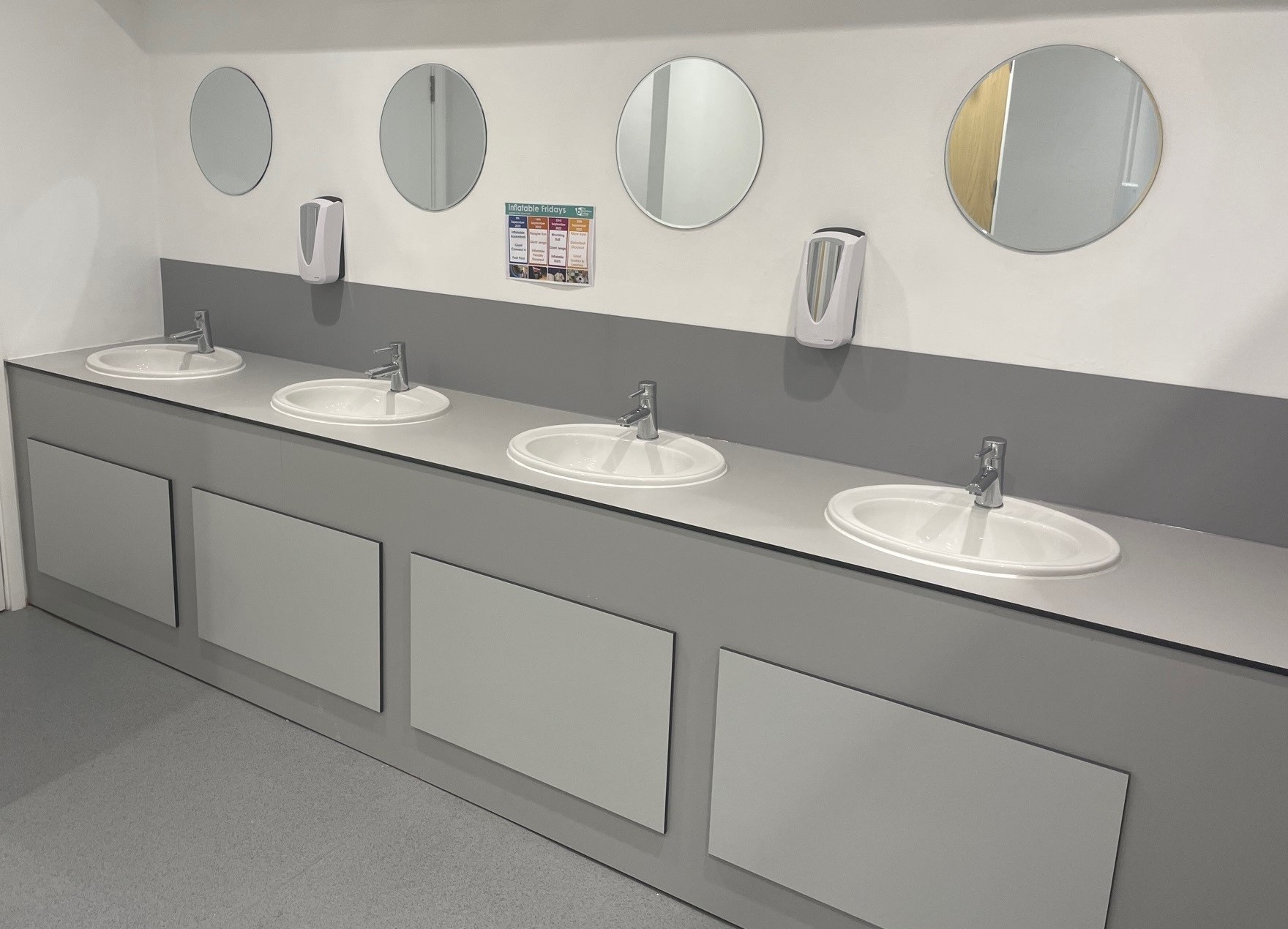
School washrooms are usually high-contact, high-wear spaces. That makes durability, privacy, supervision, hygiene and maintenance access central to specification. Robust cubicle materials, low-maintenance IPS systems and anti-vandal hardware all help support safe, durable use over years of daily traffic. Specifying robust materials, coordinated school IPS panels, and secure washroom lockers will ensure a safe, durable environment.
Primary schools
Simple wayfinding, frequent handwashing and age-appropriate layouts matter.
Secondary schools
Durability, privacy and traffic flow often become more prominent.
SEND provision
Accessibility and suitability for the users must be considered carefully.
PE and changing areas
Showers and changing accommodation may also be relevant for pupils aged 11+ receiving physical education.
Numbers and planning benchmarks
The DfE advice says the regulations do not set minimum fixture numbers by pupil ages and numbers. It then provides practical planning examples: one toilet and washbasin for every 10 pupils under 5 years old would be adequate, that ratio could be doubled for pupils aged 5–11 to one toilet and washbasin for every 20 pupils, and for pupils over 11 one toilet per 20 pupils would be sufficient , with scope to reduce washbasins where washing facilities are shared.
These benchmarks are a practical starting point for space planning, but the final number of cubicles should always be checked against the specific school's roll and layout.
Frequently Asked Questions
Does Approved Document T apply to schools?
No. Requirement T1 does not apply to schools.
Do boys' and girls' toilets need to be separate in schools?
Yes, for pupils aged 8 or over separate toilet facilities are generally required, except where the toilet facility is in a secure room intended for use by one pupil at a time.
Do the regulations set exact toilet numbers for each pupil count?
The regulations themselves do not provide a simple minimum fixture table by age and pupil number. DfE advice gives planning benchmarks instead.
What benchmark does the DfE advice give for older pupils?
For pupils over 11, the advice says one toilet per 20 pupils would be sufficient, with scope to reduce the number of washbasins where washing facilities are shared.
Related Guides
Need help with a live washroom project?
Send your room layout, pupil numbers and age range for cubicle, IPS panel and locker advice tailored to the school.