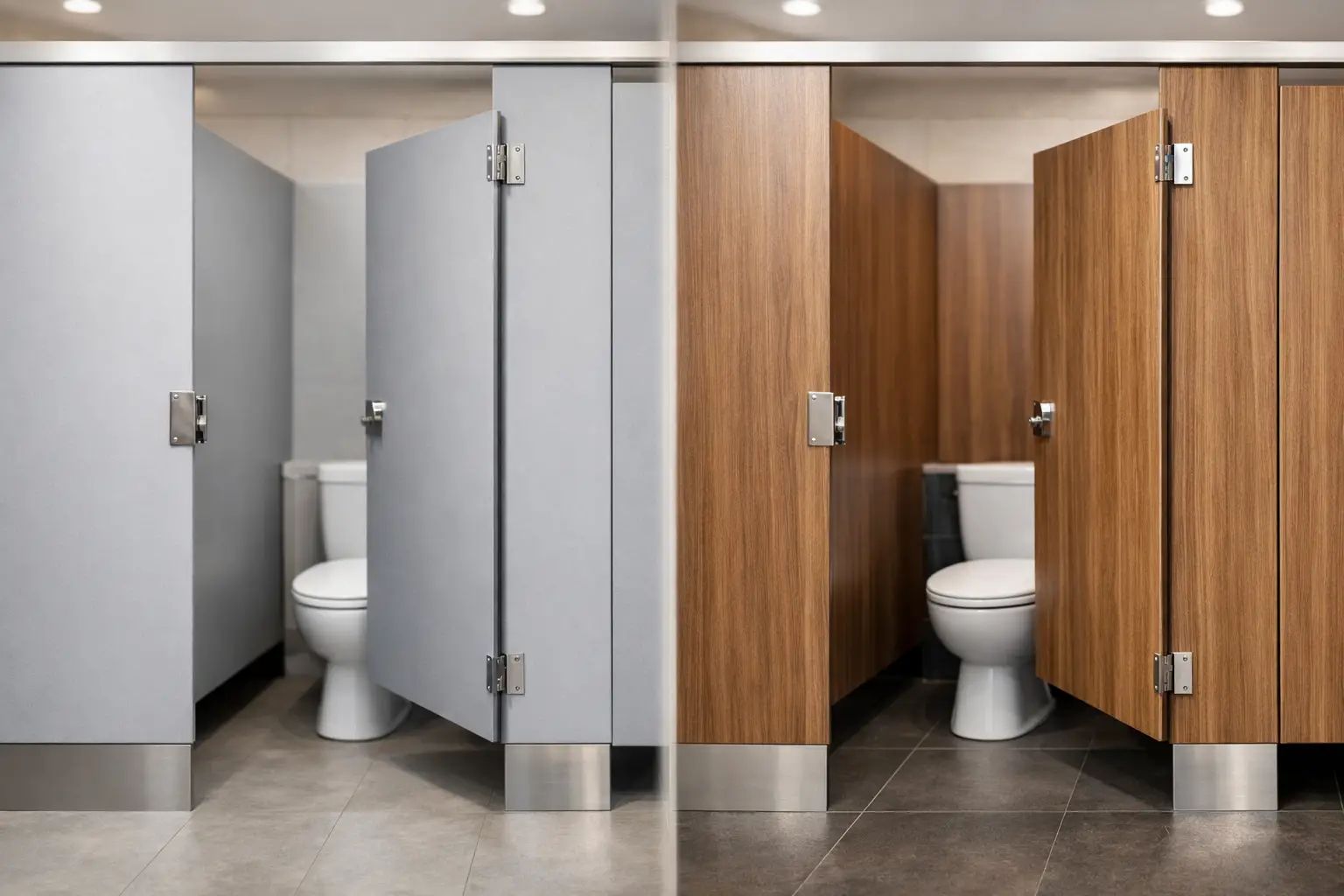
When a washroom has to cope with heavy daily use, the material choice behind the cubicles quickly becomes more than a line on a specification. The question of SGL vs MFC cubicles usually comes down to how the space will be used, how often it will be cleaned, and how long you need the system to perform without compromise.
For commercial buyers, there is no universal winner. SGL and MFC both have a place in washroom design, but they suit different environments, budgets and performance expectations. Getting that decision right early can help avoid unnecessary cost in one project, and avoid premature wear in another.
SGL vs MFC cubicles at a glance
SGL stands for Solid Grade Laminate. It is a dense, self-supporting material made for demanding environments, particularly where moisture resistance, impact strength and long-term durability matter. MFC stands for Melamine Faced Chipboard. It is a widely used board material with a melamine decorative surface, often chosen where budgets are tighter and the operating environment is less severe.
In practical terms, SGL is the more hard-wearing option, while MFC is often the more economical one. That sounds straightforward, but the right choice depends on traffic levels, cleaning regimes, user profile and the overall life expectancy of the washroom.
What matters most when comparing SGL vs MFC cubicles
The most useful way to compare these materials is not by price alone. A lower initial cost can still be the wrong commercial decision if the cubicles are going into a wet or high-abuse setting. Equally, specifying a premium material where it is not needed can place unnecessary pressure on the project budget.
Durability and impact resistance
SGL is typically the stronger material. Because it is solid throughout, it resists knocks, chips and general wear far better than lighter-duty alternatives. In schools, leisure settings and public-use washrooms, that extra resilience can make a noticeable difference over time.
MFC performs well in many commercial interiors, especially where use is moderate and the risk of damage is lower. In offices or managed staff facilities, it can provide a clean, professional finish at a lower cost point. The trade-off is that it is not as resistant to hard impact or persistent rough treatment as SGL.
Moisture resistance
This is often where the gap becomes clearer. SGL is highly suited to wet and humid environments. It stands up well where regular cleaning, splashing or higher moisture levels are part of daily operation. That makes it a strong fit for leisure centres, poolside changing areas and busy washrooms where water exposure is difficult to avoid.
MFC is generally better suited to drier environments. It can work very effectively in standard commercial washrooms, but it is not usually the first choice for heavily wet areas. Where moisture management is a concern, buyers often move towards SGL for greater long-term confidence.
Appearance and finish
Both materials can deliver a smart, modern appearance. MFC is often selected for projects where visual consistency and budget control need to sit side by side. It offers a neat, practical finish that works well in offices, education settings and many general-purpose washrooms.
SGL also offers a high-quality appearance, but its value is usually tied more closely to performance. Where a project needs a premium material that still looks sharp after sustained use, SGL tends to justify the investment.
Cost and whole-life value
MFC is usually the lower-cost option at the point of purchase, which is why it remains popular across many commercial projects. For budget-sensitive refurbishments or lower-traffic spaces, that can make it the right choice.
SGL generally carries a higher upfront cost, but the whole-life value can be stronger in more demanding settings. If a washroom is likely to face heavy use, moisture, frequent cleaning and a higher risk of misuse, paying more for a tougher material can reduce replacement pressure later.
Where SGL cubicles tend to work best
SGL cubicles are often the stronger specification for washrooms that are exposed to demanding daily conditions. In education, they are well suited to pupil washrooms and changing areas where durability matters. In leisure facilities, they are often preferred because they cope better with humidity and regular washdowns. In public sector and transport environments, they can offer the resilience needed for spaces with unpredictable levels of use.
Healthcare can also favour more durable, hygienic materials depending on the room type and cleaning requirements. Where the environment calls for dependable performance and reduced vulnerability to moisture-related wear, SGL tends to be the safer commercial choice.
This does not mean every project needs it. It means the conditions need to justify it.
Where MFC cubicles are often the better fit
MFC cubicles can be an excellent option in dry, well-managed washrooms where value for money is a key factor. Offices are a common example. Staff and visitor washrooms in professional environments often do not face the same level of impact or moisture exposure seen in schools or leisure buildings, so MFC can meet the requirement without over-specifying the material.
MFC is also a sensible choice for projects where design consistency, efficient procurement and cost control carry more weight than extreme-duty performance. In some education or administrative buildings, it may still be entirely suitable in lower-risk areas. The material is not a compromise by default – it is simply best used where its strengths align with the space.
Choosing by sector, not just by material
The most reliable specifications usually start with the building type and user behaviour. A primary school washroom has different demands from a corporate office. A dry office core has different demands from a leisure changing room. That sounds obvious, but it is where many poor decisions start – selecting by headline cost instead of actual use conditions.
If the project sits in education, leisure or high-traffic public use, SGL often moves higher up the list. If the environment is controlled, lower traffic and largely dry, MFC can represent better budget discipline without sacrificing appearance.
Architects and specifiers also need to consider cleaning intensity, expected lifespan and the client’s appetite for future maintenance risk. The best answer is often found in that balance, not in the material label alone.
Budget pressure versus performance pressure
Most commercial projects have both. The challenge is deciding which one matters more in that specific washroom.
If budget pressure is strongest, MFC may offer the most efficient route to a compliant, attractive result in suitable environments. If performance pressure is strongest, particularly around durability and moisture resistance, SGL is often easier to defend at specification stage.
There is also a middle ground. Not every area in a building needs the same material. Some buyers choose a more durable specification for pupil, public or wet zones, while using more cost-conscious options in lower-risk staff areas. That approach can help manage spend without applying the same solution everywhere.
A practical way to decide between SGL and MFC
If you are weighing up SGL vs MFC cubicles, start with four straightforward questions. How wet is the environment likely to be? How heavy is the daily traffic? How much wear or misuse is realistic? And how long does the client expect the cubicles to last before refurbishment becomes likely?
If the answers point towards heavy use, higher moisture and a longer service expectation, SGL usually makes sense. If they point towards dry conditions, moderate use and tighter budget control, MFC can be the more commercially sensible option.
This is where manufacturer support becomes valuable. A project-focused supplier can help align material choice with the building type, performance expectation and budget, rather than pushing a one-size-fits-all answer. For buyers working to programme pressure, that kind of guidance can shorten the decision process and reduce the risk of a poor specification.
The right material is the one that fits the job
SGL and MFC both have a clear place in commercial washrooms. One offers greater toughness and moisture resistance. The other offers cost efficiency and a smart finish for the right settings. The better option is the one that suits the space, the users and the client’s priorities.
If you are specifying for a demanding environment, it is usually worth leaning towards durability before problems appear. If you are working on a lower-risk interior, a well-chosen MFC system can deliver exactly what the project needs without stretching the budget. The useful question is not which material is best in general – it is which one will still feel like the right choice after years of daily use.