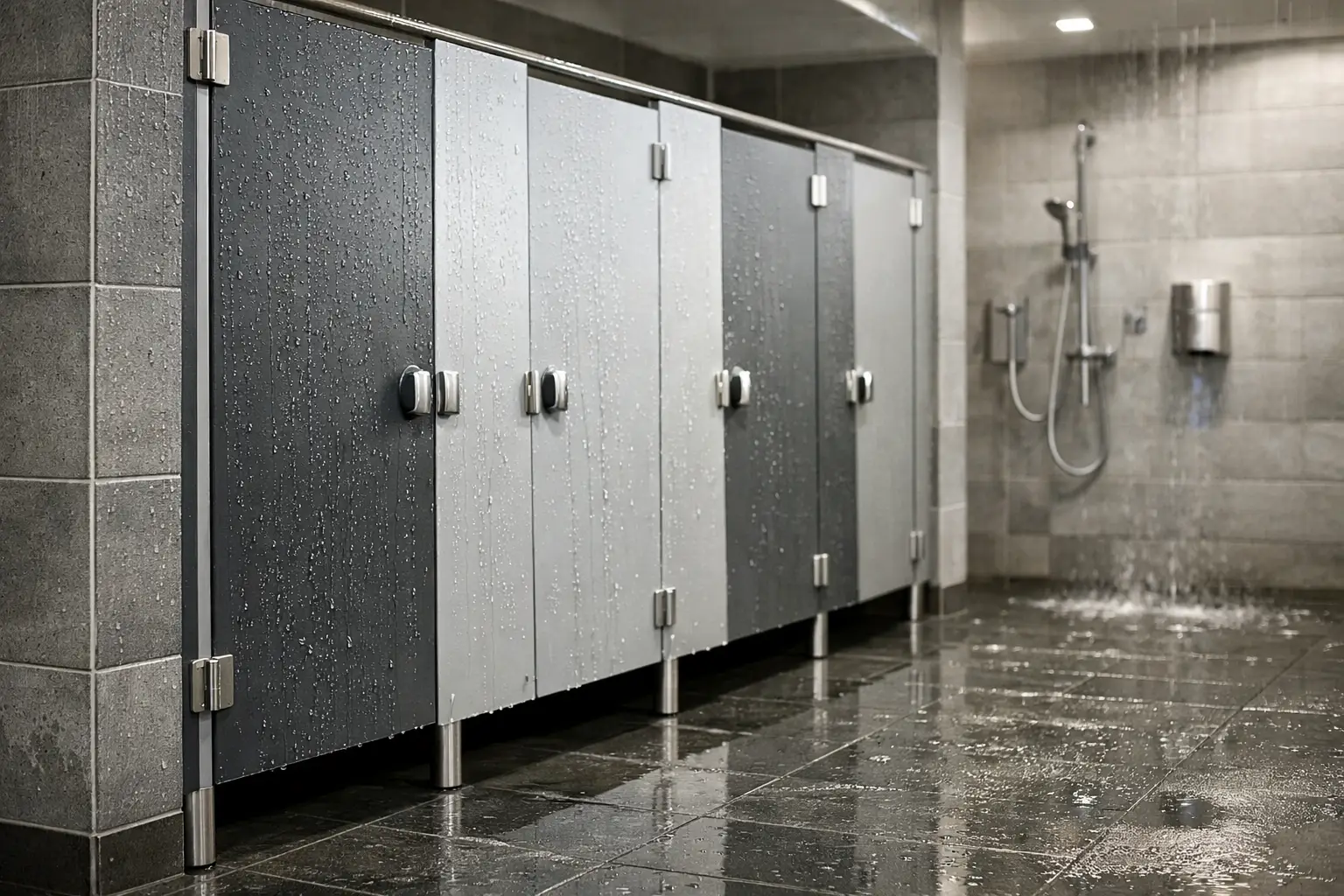
When a washroom or changing room stays damp for most of the day, standard cubicle materials can start to show their limits quickly. The best cubicles for wet areas are not simply those that look suitable on day one, but those specified to cope with repeated moisture, frequent cleaning and heavy daily use without swelling, degrading or losing their finish.
For commercial buyers, that decision affects more than appearance. It has a direct impact on lifecycle value, maintenance demands and whether the washroom continues to perform in schools, leisure sites, healthcare settings and other high-traffic environments. In wet areas, the right cubicle system is a specification issue first and a style choice second.
What makes wet areas different
Not every washroom is a true wet environment. A standard office WC with good ventilation places very different demands on cubicles than a poolside changing room, a shower block or a busy leisure facility where surfaces are exposed to regular splashing and persistent humidity.
That distinction matters because excess moisture changes how materials behave over time. Panels can absorb water, edges can deteriorate, fittings can come under more strain and surfaces may become harder to keep looking presentable. Cleaning regimes also tend to be more frequent and more intensive in these settings, so chemical resistance and surface durability become part of the conversation.
For that reason, buyers should assess the space honestly. If the area experiences regular direct water contact, high condensation or constant washdown, it usually calls for a more specialist cubicle specification than a dry or lightly damp washroom.
Best cubicles for wet areas by material
The material is usually the first and most important decision. In most genuinely wet environments, compact grade laminate is the benchmark because it is engineered for moisture resistance and suited to demanding commercial use.
Compact grade laminate for high-moisture performance
Compact grade laminate, often referred to as solid grade laminate, is widely regarded as the strongest option for wet areas. It is manufactured under high pressure to create dense, self-supporting panels that can withstand direct contact with water far better than conventional board-based products.
This makes it particularly suitable for leisure centres, swimming pools, shower areas, sports changing rooms and busy public washrooms. It also offers a strong balance of durability and presentation, which is important where buyers need the cubicles to perform well without looking overly industrial.
There is a cost consideration, of course. Compact grade laminate generally sits at a higher price point than melamine-faced or MFC-based systems. But where moisture exposure is routine, that higher upfront spend often protects the budget over the longer term by reducing premature replacement and appearance issues.
Where lower-cost materials may still work
There are commercial environments where moisture is present but controlled. In these cases, some buyers may consider more economical cubicle constructions for budget reasons, particularly in standard washrooms that are cleaned regularly but not exposed to standing water or heavy splashing.
That can be a valid approach, but only if the area is truly low-risk from a moisture perspective. If there is any doubt, the safer specification is usually the one designed for wet conditions. Saving money at the point of purchase can become expensive if the material is mismatched to the environment.
Performance factors beyond the panel material
Choosing the best cubicles for wet areas is not only about the board specification. A cubicle system performs as a whole, and weaker details elsewhere can undermine a good material choice.
Edges, fittings and hardware
In wet environments, exposed edges and low-grade ironmongery tend to fail earlier than buyers expect. Moisture finds weak points first, so the quality of the edge finish, brackets, pedestals and fixings matters. Hardware should be selected with corrosion resistance in mind, especially in changing areas with frequent washdown or chlorinated atmospheres.
A well-designed cubicle system should be built for repeated commercial use rather than occasional use. That means sturdy fittings, reliable door hardware and panel stability that does not diminish under constant humidity.
Privacy and user comfort
Wet areas often sit within changing facilities, and that changes the privacy requirement. In a school or office washroom, a standard cubicle arrangement may be suitable. In a leisure or sport setting, increased privacy is often expected, particularly where users are changing clothes and moving between showers and lockers.
This is where full-height or higher-privacy formats can be worth considering, depending on the setting and the user group. The correct solution depends on traffic levels, safeguarding considerations and the type of facility being specified.
Cleaning and long-term appearance
A cubicle that resists water but quickly shows wear from aggressive cleaning is not the right answer either. Commercial wet areas need surfaces that are easy to maintain and retain a professional appearance over time. That matters in customer-facing settings and equally in schools, hospitals and public buildings where poor presentation can create the impression of neglect.
Smooth, durable, easy-clean surfaces help facilities teams manage hygiene standards more efficiently. They also support consistency across a wider washroom scheme when coordinated with IPS panels, vanity units and wall cladding.
Matching the cubicle specification to the sector
Wet area requirements vary by sector, so the best specification is usually the one aligned with the actual use case rather than the broad category of washroom cubicles.
Leisure and sports facilities
These are typically the most demanding environments. Poolside humidity, shower spray, heavy footfall and frequent cleaning all point towards compact grade laminate as the practical choice. Buyers in this sector also tend to need a robust finish, dependable hardware and coordinated changing room products to create a complete, hard-wearing scheme.
Schools and colleges
Education settings are more mixed. A standard pupil washroom may not need a full wet-area cubicle specification, but sports pavilions, PE changing rooms and shower zones often do. The challenge in schools is balancing budget, durability and safeguarding needs while making sure the chosen material is appropriate for the level of moisture exposure.
Healthcare and public sector buildings
In healthcare and wider public sector estates, specification decisions are often shaped by lifecycle value and cleaning requirements as much as initial cost. Wet rooms, staff changing areas and shower facilities benefit from moisture-resistant cubicles that continue to perform under demanding hygiene regimes.
Offices and commercial workplaces
Most office washrooms are not true wet areas, but workplace showers and changing spaces increasingly are. Where active travel facilities are part of the fit-out, the cubicle specification should reflect that shift. A product suited to a dry WC core may not be the right solution for a showering and changing environment.
What commercial buyers should ask before specifying
Before selecting a range, it helps to ask a few direct questions. Will the panels face regular direct water contact, or mainly ambient humidity? How intensive is the cleaning regime? Is the area front-of-house, back-of-house or mixed use? Does privacy need to go beyond a standard washroom format? And is the objective lowest initial outlay, or stronger whole-life value?
Those answers usually narrow the field quickly. They also help avoid over-specifying a dry environment or under-specifying a genuinely wet one. Both mistakes cost money, just in different ways.
For project-led buyers, support during the specification stage can make a measurable difference. A manufacturer with UK production, broad product choice and technical consultation can help align material, layout and lead-time expectations early, which is especially useful where multiple washroom and changing room elements need to work together.
The best cubicles for wet areas are the ones built for the reality of the space
There is no single cubicle range that suits every damp or humid environment. The right choice depends on water exposure, cleaning intensity, user expectations and budget. But in most genuinely wet commercial settings, compact grade laminate remains the strongest all-round answer because it is designed to cope with the conditions rather than merely tolerate them.
For buyers specifying schools, leisure centres, healthcare spaces or workplace changing rooms, the main priority is not choosing the cheapest option or the most decorative one. It is choosing a system that will still look right and perform properly after sustained commercial use. That is where experienced manufacturing support adds real value, particularly when speed, consistency and specification confidence all matter.
If the environment is wet, the cubicle specification should be honest about it. That usually leads to a better product decision and fewer problems later.