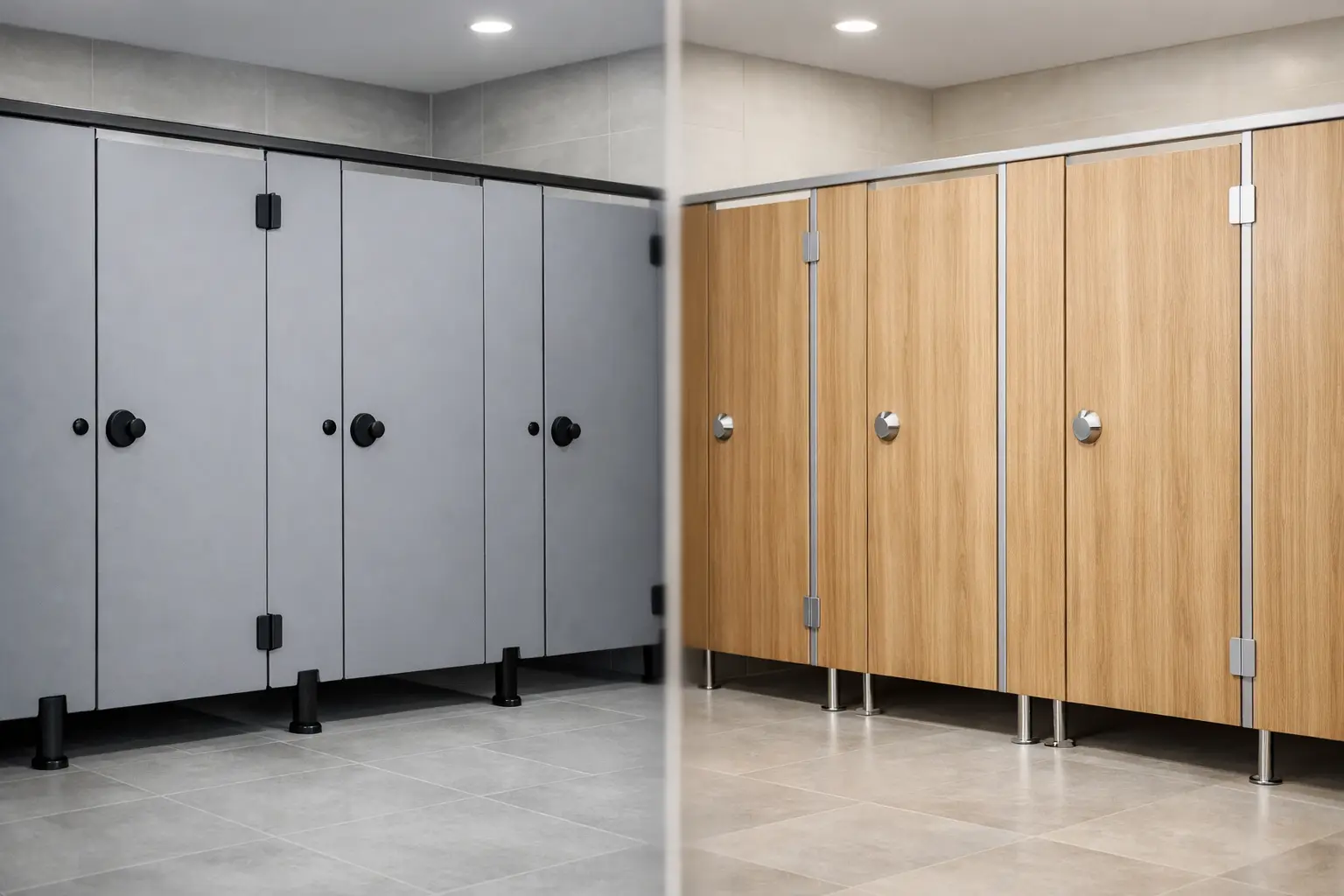
A school washroom refurbishment, a leisure centre changing area and an office fit-out can all need cubicles – but they do not all need the same board material. When buyers compare sgl vs hpl cubicles, the right answer usually comes down to how the space will be used, how hard it will be worked and how long the installation needs to last.
For contractors, specifiers and facilities teams, this is not just a material choice. It affects durability, appearance, whole-life value, cleaning performance and how confidently the finished washroom will cope with daily traffic. The best specification is the one that matches the environment rather than simply choosing the cheapest or heaviest-duty option by default.
SGL vs HPL cubicles at a glance
SGL stands for solid grade laminate. It is a dense, self-supporting material made from layers of kraft paper and resin compressed under high pressure. Because the core is solid, the panel is highly resistant to impact, moisture and wear. In washroom terms, it is widely chosen for demanding environments where reliability matters more than lowest upfront cost.
HPL stands for high pressure laminate. In cubicle construction, HPL generally refers to a decorative laminate bonded to a core, often moisture-resistant chipboard or MDF, depending on the range and application. This creates a cost-effective panel with a good finish and solid everyday performance in many commercial interiors.
On paper, both can work well. In practice, the difference is in where they work best. SGL is typically the stronger choice for wet and high-abuse settings, while HPL is often a sensible option for dry or moderately used washrooms where budget control is a key part of the brief.
What is the practical difference between SGL and HPL?
The easiest way to think about it is structure. SGL is solid throughout, so there is no separate face and core that can be compromised if edges or surfaces are damaged. That makes it especially dependable where water, humidity and heavy use are part of everyday operation.
HPL cubicles rely on the performance of both the laminate face and the substrate beneath it. In the right environment, that is absolutely suitable and often commercially attractive. But in harsher conditions, especially where standing water or repeated saturation is likely, the core becomes an important consideration.
This is why two washrooms with similar layouts may need very different specifications. A staff toilet in a low-traffic office and a poolside changing village may both require privacy and easy cleaning, but they place completely different demands on the cubicle system.
When SGL cubicles are usually the better choice
SGL earns its place in projects where durability is under pressure from people, moisture or both. Leisure facilities are the obvious example. In wet changing areas, pool surrounds and shower-adjacent spaces, water resistance is not a nice-to-have. It is central to long-term performance.
Education can be another strong fit, particularly in secondary schools and colleges where cubicles need to tolerate high traffic and occasional misuse. The material’s density helps it stand up well to knocks, and its moisture resistance supports easier maintenance in busy washrooms.
Healthcare and public-use facilities also often benefit from SGL where hygiene, reliability and service life matter. If the project brief points towards a premium lifespan, reduced replacement risk and strong day-to-day resilience, SGL is usually worth the extra initial spend.
There is also a visual benefit. SGL can deliver a clean, modern commercial finish with slim but strong panels, which suits contemporary washroom designs where appearance still needs to be backed up by performance.
Best-fit environments for SGL
SGL is typically well suited to leisure centres, swimming pools, schools, transport hubs and heavily used public washrooms. It also makes sense in changing areas and shower spaces where high humidity is routine rather than occasional.
That does not mean SGL is necessary everywhere. It means it is often the safer specification where failure would be disruptive, expensive or reputationally damaging.
When HPL cubicles make more commercial sense
HPL cubicles remain a very practical option for a large share of commercial projects. If the washroom is in a dry internal environment, used in a controlled way and maintained properly, HPL can provide an excellent balance of cost, appearance and functionality.
Office washrooms are a common example. Many workplace environments do not expose cubicles to the same level of water, impact or intensive traffic seen in schools or leisure facilities. In that context, HPL can be the more efficient use of budget, especially where multiple washrooms are being fitted out across a wider scheme.
Lower-traffic public buildings, managed commercial premises and some administrative areas in the public sector can also be suitable. The key point is that HPL is not a compromise when it is specified appropriately. It is a sensible commercial solution for the right setting.
For projects under cost pressure, HPL may also help free budget for other priorities, such as IPS panels, vanity units or coordinated washroom finishes. That matters in real procurement decisions, where value is often measured across the full package rather than one product line in isolation.
Cost, lifespan and whole-life value
Initial cost is often where the sgl vs hpl cubicles discussion starts, but it should not be where it ends. SGL usually carries a higher upfront price because it is a more substantial material with stronger performance credentials. HPL is generally more budget-friendly at point of purchase.
However, whole-life value depends on use. In a demanding environment, specifying HPL purely to reduce capital cost can become a false economy if panels deteriorate sooner or require earlier replacement. Equally, specifying SGL into a low-stress office washroom may add cost without delivering a proportionate operational benefit.
The better question is not which material is cheaper. It is which material is most cost-effective for the expected duty level over the life of the fit-out.
This is where experienced manufacturing and specification support add real value. Matching the board material to traffic levels, cleaning regimes and exposure to moisture can protect both the budget and the programme.
Appearance, finish and design flexibility
Both SGL and HPL cubicles can deliver a professional finish suitable for modern commercial interiors. Colour choice, hardware selection and overall cubicle style will often have just as much impact on appearance as the core material itself.
That said, material choice can influence the feel of the installation. SGL tends to project a more premium, hard-wearing character, particularly in high-spec or high-demand settings. HPL can achieve a smart, clean result very effectively and may be the preferred route where the design brief is strong but the budget has to remain disciplined.
For schools, offices and public sector projects, consistency across cubicles, IPS and vanity units can be just as important as the standalone board choice. A coordinated package can simplify procurement and help the finished washroom feel intentional rather than pieced together.
Installation and project planning considerations
Material performance is only one part of the decision. Lead times, manufacturing support and suitability for the wider fit-out programme matter as well. On a live refurbishment or time-sensitive handover, having the right product available on the right schedule can be as important as a marginal difference in specification.
SGL can be heavier and more substantial to handle, which is worth factoring into installation planning. HPL systems may support a more economical approach on projects where speed and budget need to be tightly managed. Neither point is a reason to choose one automatically, but both belong in the conversation.
For many buyers, the strongest route is to review the material alongside layout, compliance needs, hardware, finish options and delivery programme at the same time. That avoids making a narrow material decision that creates wider project problems later.
How to choose between SGL and HPL cubicles
If the washroom is likely to face persistent moisture, heavy traffic or a high risk of impact damage, SGL is usually the more dependable specification. It is particularly well suited to leisure, education and public-facing environments where long-term resilience matters.
If the area is dry, moderately used and budget-sensitive, HPL may be the better commercial fit. It can provide a professional finish and reliable everyday performance without overspecifying the project.
The most effective specifications are rarely based on generic rules. They are based on how the building will actually operate. A dependable manufacturer should be able to look at the setting, the expected usage and the programme, then guide you towards the most suitable solution with confidence. That is often the difference between simply buying cubicles and specifying a washroom system that keeps performing long after handover.
If you are weighing up materials for an upcoming project, it helps to start with the environment first and the board type second. That usually leads to a clearer decision, a better fit-out and fewer compromises once the washroom is in use.