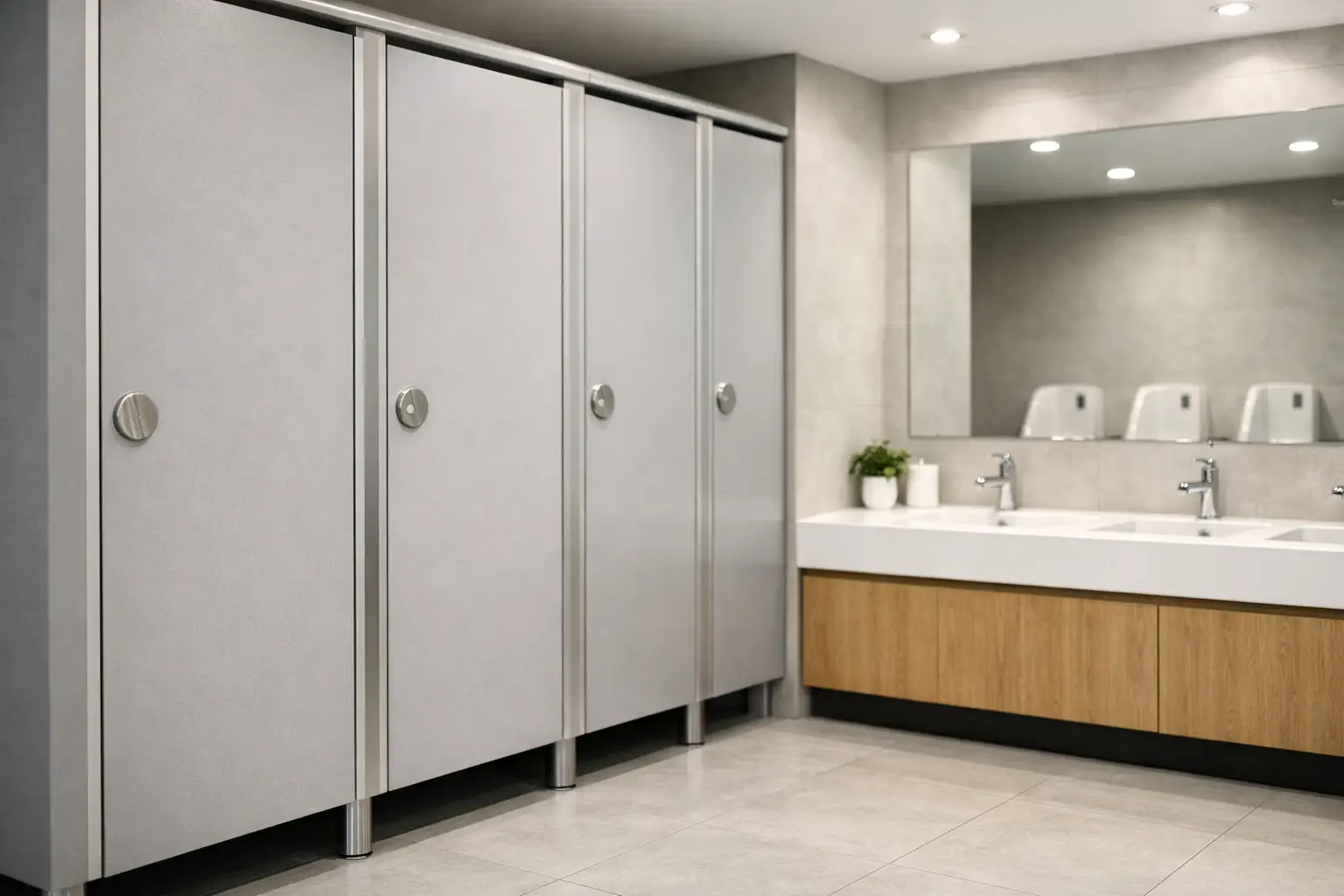
If you are pricing a commercial washroom fit-out and trying to balance appearance, lead times and budget, this MFC washroom panels guide will help you make a sound specification choice. MFC panels are widely used across toilet cubicles, vanity units and duct panelling because they offer a clean finish, dependable performance in the right environment and good value for many commercial projects.
That said, MFC is not a one-size-fits-all answer. The right panel choice depends on traffic levels, cleaning regimes, moisture exposure and the expected life of the installation. For schools, offices and many dry-area washrooms, MFC is often a practical and cost-effective option. For heavy-duty wet spaces, there may be better alternatives.
What MFC means in washroom panel specification
MFC stands for melamine faced chipboard. In simple terms, it is an engineered core board with a decorative melamine surface bonded to both faces. That surface gives the panel its finished colour and provides a level of resistance to scratches, staining and day-to-day wear.
In commercial washrooms, MFC is commonly specified for cubicle doors, pilasters, partitions and coordinated vanity units where the environment is controlled and not constantly wet. It is popular because it gives a smart, uniform appearance, works well across a broad range of décors and can be manufactured accurately to project dimensions.
For specifiers and contractors, one of the main advantages is predictability. MFC is a well-understood material with a consistent finish, and it suits fast-turnaround projects where budget control matters. It also allows coordinated washroom systems, which is useful when you want cubicles, IPS panels and vanity units to sit together visually.
An MFC washroom panels guide to where it works best
MFC performs best in internal washrooms where there is regular use but not constant surface saturation. Typical examples include office washrooms, school staff toilets, pupil washrooms with suitable ventilation, retail customer toilets and many public sector refurbishments.
It is especially effective where the brief calls for a tidy, durable installation without moving into the cost bracket of more specialist solid grade materials. In these settings, MFC often delivers the right balance between price and performance.
The key point is that MFC is usually suited to dry or moderately humid environments rather than direct wet zones. If water is allowed to sit on exposed edges, or if the room experiences repeated high moisture with poor ventilation, service life can be reduced. This is why good detailing, correct edging and sensible maintenance matter just as much as the panel itself.
What commercial buyers look for in MFC panels
From a procurement or specification perspective, the value of MFC is not just the board. It is the full system around it. Panel thickness, edge treatment, ironmongery, support hardware and manufacturing accuracy all affect how the installation performs on site.
A well-made MFC washroom panel should have a hard-wearing decorative face, clean machined edges and suitable lippings or edging to protect vulnerable points. The panel also needs to be matched to the application. A primary school washroom has different demands from an executive office fit-out, even if both use MFC.
Finish choice matters too. Lighter colours can help smaller washrooms feel cleaner and brighter, while darker tones may show water marks less in some settings but highlight dust or surface wear in others. Woodgrain effects remain popular in offices and hospitality-led spaces, while plain colours are often preferred in education and public buildings for easier coordination.
The main advantages of MFC washroom panels
The reason MFC remains a strong commercial choice is straightforward. It offers good visual consistency, practical durability and budget efficiency across a wide range of projects.
Cost control is often the first driver. When compared with more premium panel materials, MFC can reduce material spend while still delivering a professional finish suitable for many specification-led environments. For refurbishments with fixed budgets, that can make the difference between replacing only cubicles and delivering a more complete washroom upgrade.
Lead times can also be a deciding factor. UK manufacturing support and made-to-measure production help projects move quickly, particularly where drawings, site dimensions and coordinated items are required. For contractors working to tight programmes, this is not a minor benefit.
MFC also offers design flexibility. A broad selection of colours and finishes makes it easier to match branding, school themes or wider interior schemes. When panels are manufactured as part of a complete system, the result is usually cleaner and easier to install than trying to piece together products from multiple sources.
The limitations buyers should factor in
No honest MFC washroom panels guide should ignore the trade-offs. MFC is durable for the right use case, but it is not the best answer for every washroom.
Its main limitation is moisture sensitivity at exposed points. The melamine face itself is durable, but if water penetrates damaged edges or poorly sealed junctions, the chipboard core can swell over time. This does not mean MFC is unsuitable for washrooms. It means specification and installation standards need to be appropriate to the environment.
Heavy impact is another consideration. In high-abuse settings, particularly where misuse is common, more dense or specialist materials may offer better long-term value despite the higher initial cost. Leisure centres, some transport facilities and intense wet changing areas often need a more hard-wearing approach.
Cleaning regimes also affect performance. Harsh chemicals, repeated soaking and poor ventilation can shorten the lifespan of any panel product, but MFC is less forgiving than fully water-resistant alternatives when maintenance is poor.
How to decide whether MFC is right for your project
The best starting point is to assess the washroom by risk rather than by assumption. Ask how much water will regularly contact the panels, who will use the space, how often it will be cleaned and what level of wear is realistic over five to ten years.
In a standard office washroom, MFC is commonly a sensible choice because the environment is usually controlled, usage patterns are predictable and appearance matters. In a school, it can also work very well, provided the product range is designed for education use and the hardware is selected with durability in mind.
If the project includes showering or changing spaces with persistent moisture, you may need to review whether a different panel construction would provide better whole-life value. Lower upfront cost is not always lower project cost if replacement cycles are shortened.
This is where manufacturer input becomes useful. A supplier with technical experience can advise whether MFC is appropriate for the application, or whether another panel material would better suit the duty level, cleaning regime and budget.
Specification details that make a difference
A lot of panel failures are not caused by the face finish. They come from poor detailing. Edge protection, fitting accuracy and hardware quality all influence how the system performs after handover.
Pay attention to panel thickness, edge finish and the way panels meet floors, walls and duct sets. Toilet cubicles in busy environments need stable fixings and dependable hardware, not just attractive board finishes. IPS access panels and vanity units should also be coordinated so that service access remains straightforward without compromising the overall appearance.
It is also worth considering replacement practicality. In larger estates such as schools or public buildings, the ability to reorder matching panels or additional items later can save time and reduce inconsistency across phases.
Why UK manufacturing support matters
For commercial washroom projects, material choice is only part of the buying decision. Lead-time certainty, drawing support and responsive communication are often just as important.
Working with a UK manufacturer can help reduce delays, simplify revisions and give specifiers more confidence that the final product will match the project brief. Where site conditions change or dimensions need refining, access to consultation and optional CAD support can keep a programme moving.
That is particularly relevant on refurbishments, where existing building conditions rarely behave exactly as expected. A dependable supply partner can make the difference between a straightforward installation and a series of avoidable site adjustments.
With more than 45 years in the industry, Total Cubicles understands that buyers do not just need panels. They need a washroom system that suits the building, arrives when promised and performs as expected once installed.
Final thought
MFC panels remain a strong commercial washroom option because they solve a real project need: good appearance, sensible cost and reliable performance in the right setting. The key is to specify them with clear eyes. If the environment is suitable and the system is properly made, detailed and installed, MFC can be a very effective choice for modern commercial washrooms.