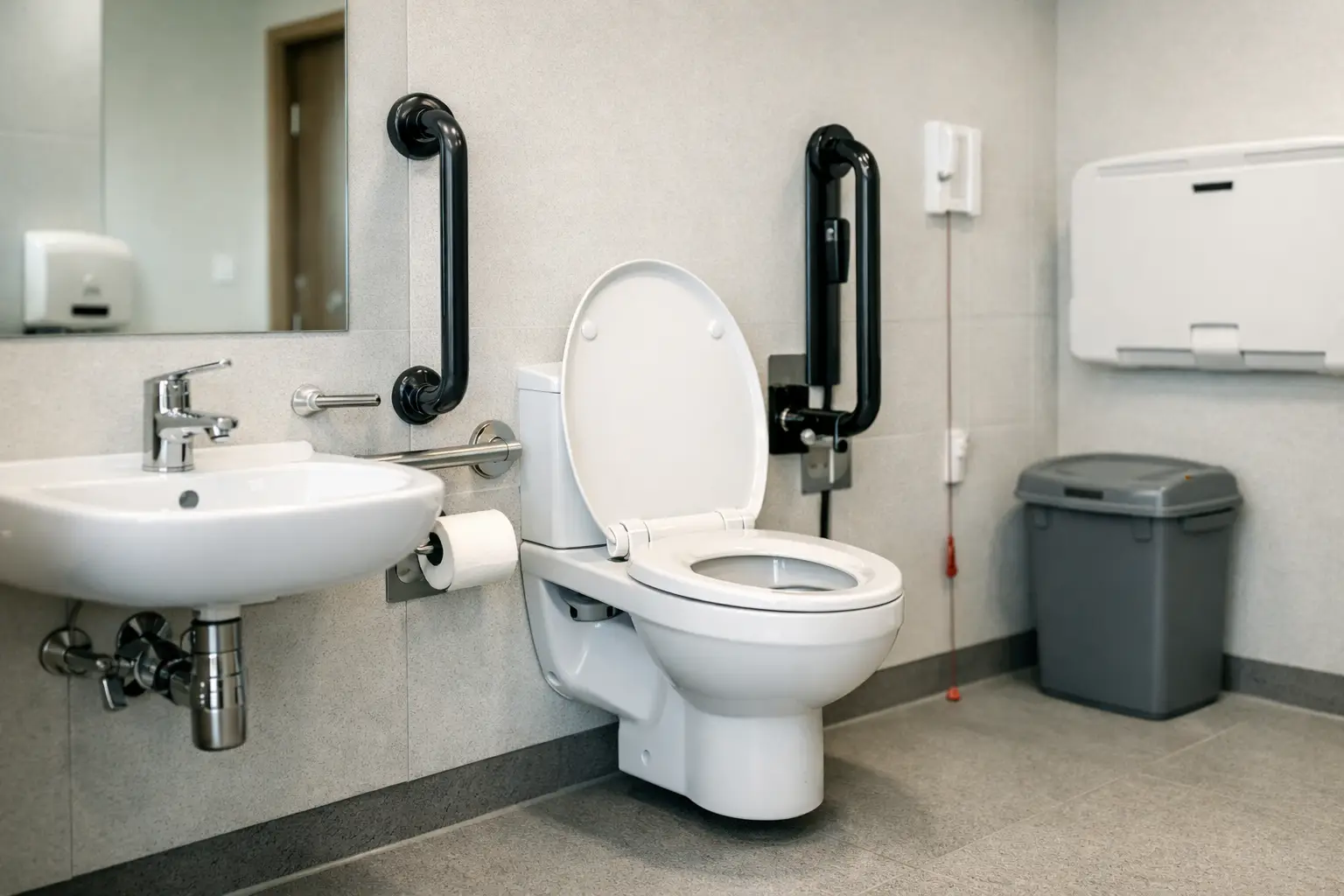
A toilet layout can pass basic building control checks and still feel awkward, exposed or exclusionary in daily use. That is why Approved Document T toilets matter. For commercial washrooms, schools, leisure sites and public buildings, this guidance pushes the conversation beyond minimum provision and towards spaces that work better for the people using them.
For specifiers and project teams, Approved Document T is not just another compliance document to file away. It affects how toilets are planned, how privacy is handled, how inclusive provision is considered and how different user needs are balanced within a single washroom scheme. If you are designing a new facility or refurbishing an existing one, understanding where Document T sits alongside other washroom requirements can save time later and reduce costly redesigns.
What Approved Document T means for toilets
Approved Document T supports the requirement for toilet accommodation in new non-domestic buildings and certain building work in England. Its focus is toilet provision that is usable, inclusive and appropriate for a broader range of people. In practical terms, that means teams need to think carefully about who will use the building and whether the proposed facilities match that pattern of use.
This is where some confusion can arise. Approved Document T does not replace all the other guidance that specifiers already work with. It sits within a wider compliance picture that may also include Building Regulations requirements on accessibility, hygiene, welfare, safeguarding and circulation. For many projects, it will need to be considered alongside Approved Document M and any sector-specific standards or client requirements.
That matters because toilet design is rarely about one rule in isolation. A school washroom, for example, may have very different privacy expectations and supervision considerations compared with an office washroom or a leisure changing village. A healthcare setting may need a stronger focus on cleaning regimes, infection control and assisted use. The principle is the same, but the correct solution depends on the building type, user group and operational reality.
Why Approved Document T toilets change washroom planning
The practical effect of Approved Document T toilets is that project teams are being asked to plan with more care at the early stages. It is no longer enough to count cubicles and place sanitaryware where it fits. The quality of the layout matters.
Privacy is a clear example. Users need facilities that feel dignified and secure, but that can be achieved in different ways. Full-height cubicles may improve privacy in some environments, while in others the need for management visibility or cleaning access might point towards a different configuration. There is rarely one perfect answer for every site.
Inclusive provision is another key issue. Some users want self-contained spaces. Others benefit from layouts that are simple to understand and easy to navigate. Parent and child use, ambulant access, enlarged cubicles and accessible facilities all need proper consideration. On busy commercial projects, those details are sometimes left until late in the programme, when flexibility has already narrowed.
This is one reason many contractors and specifiers prefer a coordinated washroom package rather than piecing products together from several sources. When cubicles, IPS, vanity units and wall finishes are considered as one system, it is easier to align the final fit-out with the intended user experience as well as the compliance brief.
Key design points to review early
The best time to address Document T implications is before product specification is fixed. By that stage, room sizes, door swings, service positions and circulation routes may already be constraining what can realistically be delivered.
Start with user mix. A primary school, sixth form block, council office and sports pavilion will all generate different patterns of use. Peak demand, age range, supervision needs and expected traffic levels should all shape the washroom layout. A design that looks efficient on plan may perform poorly once the building is occupied.
Then look at privacy and dignity in practical terms. Sightlines into the washroom, cubicle door positioning, shared handwashing areas and the relationship between entrance points and sanitary spaces all deserve attention. Small changes at planning stage can make a marked difference to user comfort.
Materials also play a part. High-traffic environments need systems that withstand frequent cleaning, impact and moisture without quickly looking tired. That is not only a maintenance issue. A washroom that remains well presented supports user confidence and reduces complaints. In schools and public sector buildings especially, durability and appearance are closely linked.
Approved Document T toilets and accessibility
Accessibility cannot be treated as a separate exercise after the main layout is complete. Approved Document T toilets are part of a broader expectation that facilities should work for a wide range of users, and that includes accessible and ambulant provision being properly integrated into the design process.
The trade-off is usually space. Commercial projects often face pressure on footprint, particularly in refurbishment schemes where the washroom envelope is fixed. Enlarging one area may reduce standard cubicle numbers or affect vanity runs and service zones. There is no value in ignoring that tension. It is better to address it openly and develop a layout that works operationally than to force a nominally compliant plan that performs badly in use.
This is where manufacturer input can be useful. Practical design support, including CAD layout work, can help teams test cubicle sizes, door clearances, panel arrangements and IPS coordination before the job reaches site. On tighter programmes, that can prevent avoidable delays and rework.
Choosing products that support compliance
Compliance starts with design, but products still matter. Poorly chosen systems can undermine a well-planned layout. In commercial washrooms, specification should account for traffic level, cleaning regime, expected lifespan and installation method as well as appearance.
For example, education settings often need anti-vandal, easy-clean cubicle systems with strong privacy performance and fast replacement potential if individual components are damaged. Office environments may place greater emphasis on finish quality and visual consistency. Leisure and wet areas may require materials with stronger moisture resistance and more demanding edge protection.
IPS panels and vanity units should also be selected with maintenance in mind. Concealed services improve appearance, but access for future repairs still needs to be straightforward. If routine maintenance becomes difficult, whole-life cost rises quickly. The right washroom package should support both the design intent and the building’s day-to-day operation.
For buyers working to programme pressure, lead times are another practical consideration. A specification that is technically right but impossible to deliver within the project window creates its own risk. UK manufacturing capacity, clear technical advice and responsive quotation support can make a significant difference when projects are moving quickly.
Refurbishment projects need a different approach
New-build schemes usually offer more freedom. Refurbishment projects do not. Existing drainage runs, structural constraints, dated room proportions and legacy compliance issues can all limit the options.
That does not mean Document T principles should be treated as secondary. It means the project team needs a realistic approach. In some refurbishments, the best outcome may involve improving privacy, circulation and inclusivity within the available envelope rather than trying to replicate an ideal new-build layout that the space simply cannot support.
This is often where experienced washroom manufacturers add value. A practical review of room dimensions, product sizes and installation tolerances can identify options that are not obvious from a generic drawing alone. For buyers responsible for schools, offices and public buildings, that kind of early technical input can keep the project moving.
Getting Approved Document T toilets right in practice
The strongest toilet schemes are rarely the most complicated. They are the ones where user needs, compliance duties, maintenance realities and budget have been considered together from the outset. Approved Document T brings useful focus to that process.
For specifiers, contractors and facilities teams, the main lesson is simple. Treat toilet provision as part of the building’s performance, not just a finishing package. Ask how the space will be used at busy times. Consider privacy before panels are ordered. Check that accessibility is built into the layout, not added at the edge. Make sure the selected products can withstand the environment they are going into.
With more than 45 years in the industry, Total Cubicles sees this first-hand across education, office, leisure and public sector projects. The washrooms that work best are the ones planned with clear technical thinking and delivered with products that are made for commercial use.
If Approved Document T prompts earlier conversations about dignity, inclusion and practical fit-out decisions, that is a positive shift for the industry and for the people who use these spaces every day.