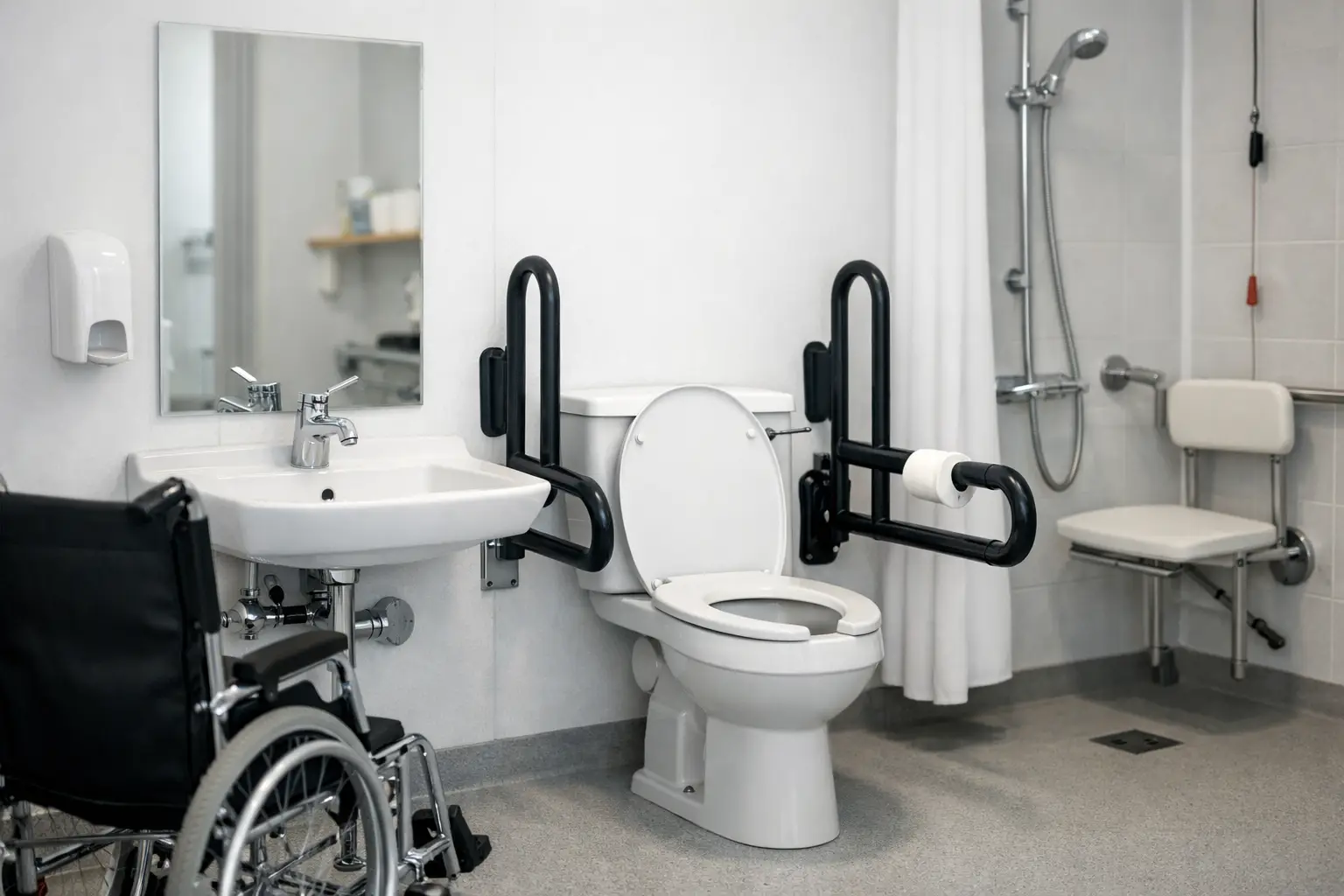
If a washroom layout looks workable on paper but fails on access, the cost shows up later in redesigns, delays and awkward compromises on site. That is why Approved Document M washrooms need to be considered early, not treated as a final compliance check once products have already been chosen.
For contractors, architects, facilities teams and school or public sector buyers, Approved Document M is less about ticking a box and more about making a washroom genuinely usable. It affects space planning, door swing, turning circles, cubicle arrangement, fittings, vanity layouts and the relationship between every component in the room. Get it right at specification stage and the rest of the project usually runs more smoothly.
What Approved Document M means for washrooms
Approved Document M supports the Building Regulations in England and sets out guidance on access to and use of buildings. In washrooms, that means creating spaces people can approach, enter and use safely and with dignity. It applies to far more than wheelchair-accessible cubicles alone.
In practice, Approved Document M washrooms are shaped by clear dimensional and usability requirements. These often include accessible WC layouts, outward opening doors where required, support rails, suitable basin positions, mirror heights, manoeuvring space and fittings that can be reached without strain. The principle is straightforward, but real projects are rarely simple because every site has constraints.
Refurbishments, in particular, can be challenging. Existing drainage runs, structural walls, ceiling heights and inherited room proportions can all limit what is possible. That does not remove the need for compliance, but it does mean the design process has to be practical and informed from the start.
Why compliance decisions should happen early
The biggest mistake on commercial washroom projects is treating compliance as a product issue when it is really a layout issue first. A compliant cubicle range on its own will not solve a poor room arrangement. If the door clashes with circulation, the basin projects too far, or the transfer space is compromised by a duct boxing, the specification can fail even if every item is technically suitable.
Early planning also helps control budget. Moving partitions, changing door configurations or revising IPS layouts late in the programme is usually more expensive than resolving them at drawing stage. For high-volume sectors such as education, leisure and office refurbishment, small mistakes repeated across multiple washrooms quickly add up.
This is where practical manufacturer input can be useful. A supplier that understands cubicles, IPS panels, vanity units and wall finishes as a complete washroom package can often spot interface issues before they become site problems.
Key design points in Approved Document M washrooms
Accessible washroom compliance is built around dimensions and usability, but those rules affect specification in very practical ways. The room has to function for the user, not just meet a nominal drawing requirement.
Space and circulation
Turning space is one of the first pressure points. On many projects, especially refits, the room may technically include the required fixtures but still feel cramped because manoeuvring space has been eroded by oversized duct panelling or poorly positioned vanity furniture. Clear floor area matters just as much as fixture selection.
Door operation is another common issue. The direction of opening, ironmongery choice and the amount of clear space available on both sides of the entrance can all affect whether the room works properly. A compliant layout on plan can become non-compliant once product depths and frame details are added.
Cubicles and access zones
Not every washroom needs the same cubicle arrangement, and that is where experience counts. Schools, offices, healthcare settings and leisure facilities all have different user profiles and traffic patterns. The accessible provision has to fit the building type while still meeting the relevant guidance.
A standard bank of cubicles may need to be reworked to accommodate an enlarged cubicle, ambulant provision or a separate unisex accessible WC. The trade-off is usually between capacity and access. On tight footprints, buyers often need to decide whether to prioritise cubicle count or create a more comfortable and future-proof layout.
Basins, mirrors and accessories
Basin placement is often underestimated. The projection from the wall, surrounding clearance, tap choice and relationship to support rails all affect ease of use. The same applies to soap dispensers, hand dryers and mirrors. If accessories are mounted as an afterthought, they can easily end up outside convenient reach ranges or obstruct circulation.
That is why coordinated specification matters. When vanity units, IPS systems and cubicle fronts are considered together, it is easier to maintain consistency in dimensions, finishes and usability.
Specification challenges by sector
Different buildings create different risks when designing Approved Document M washrooms. A one-size-fits-all approach rarely works well.
Education
In schools and colleges, durability is often the first concern, but compliance cannot be secondary. Washrooms need to withstand heavy daily use while still providing accessible layouts, suitable privacy and easy maintenance. Space can be tight, especially in refurbishment projects, so compact but durable systems are often needed.
There is also a safeguarding and supervision element in many education environments. The layout must work for pupils, staff and maintenance teams without creating awkward blind spots or hard-to-clean details.
Offices and workplaces
Office washrooms often need a more polished finish, but the underlying compliance requirements remain. Here, the challenge is usually balancing appearance with practicality. Vanity design, IPS boxing and cubicle aesthetics should not reduce usable space or complicate cleaning.
Workplace projects also tend to be programme-sensitive. If the fit-out is tied to a handover date, product lead times and installation sequencing matter as much as the drawings.
Leisure and public-use settings
Leisure centres and high-footfall public buildings put much more pressure on materials and hardware. Moisture resistance, impact durability and maintenance access become major specification factors. In these settings, compliant design has to stand up to constant use, not just pass inspection on day one.
Materials and product choices matter
Approved Document M does not prescribe every board material or finish, but the wrong product choices can still undermine the result. Commercial washrooms need systems that hold alignment, resist wear and allow fittings to be installed accurately. If panels swell, fixings loosen or furniture edges degrade, the room becomes harder to use and maintain.
For that reason, buyers should look beyond appearance and price alone. Panel performance, hardware quality, cleaning demands and replacement practicality all have a direct effect on the long-term value of the installation. A cheaper initial choice can create higher maintenance costs and earlier refurbishment.
UK manufacturing can also make a practical difference. On projects where dimensions are tight and compliance is non-negotiable, made-to-specification products and responsive technical support reduce risk. That is especially useful when layouts need to be adjusted quickly to suit real site conditions.
Getting from concept to compliant installation
The most reliable route is to treat washroom design as a coordinated package. Start with the room dimensions and user requirements, then check circulation, fixtures, cubicle arrangement, duct panelling and accessories together. That sounds obvious, but too many projects still separate those decisions between multiple suppliers or make them in the wrong order.
Detailed drawings help, particularly where there are difficult interfaces or restricted spaces. CAD support can save time by showing exactly how doors clear, where sanitaryware sits and whether the usable space remains intact once all systems are installed. For procurement teams, that level of detail also gives more confidence before placing an order.
It is worth recognising that compliance is not always purely black and white in live projects. Some refurbishments involve inherited building constraints, and resolving them may require careful judgement. The right approach is to address the limitations openly and work toward the most practical compliant solution rather than forcing standard products into a compromised layout.
With 45 years in the industry, Total Cubicles understands that commercial washroom projects succeed when technical guidance, product durability and lead-time certainty come together. For specifiers and buyers, that usually means fewer surprises on site and a better result at handover.
Approved Document M washrooms work best when compliance is built into the plan, the products and the installation from the outset. When every element is coordinated properly, the finished space is not only easier to sign off – it is easier for people to use every day.