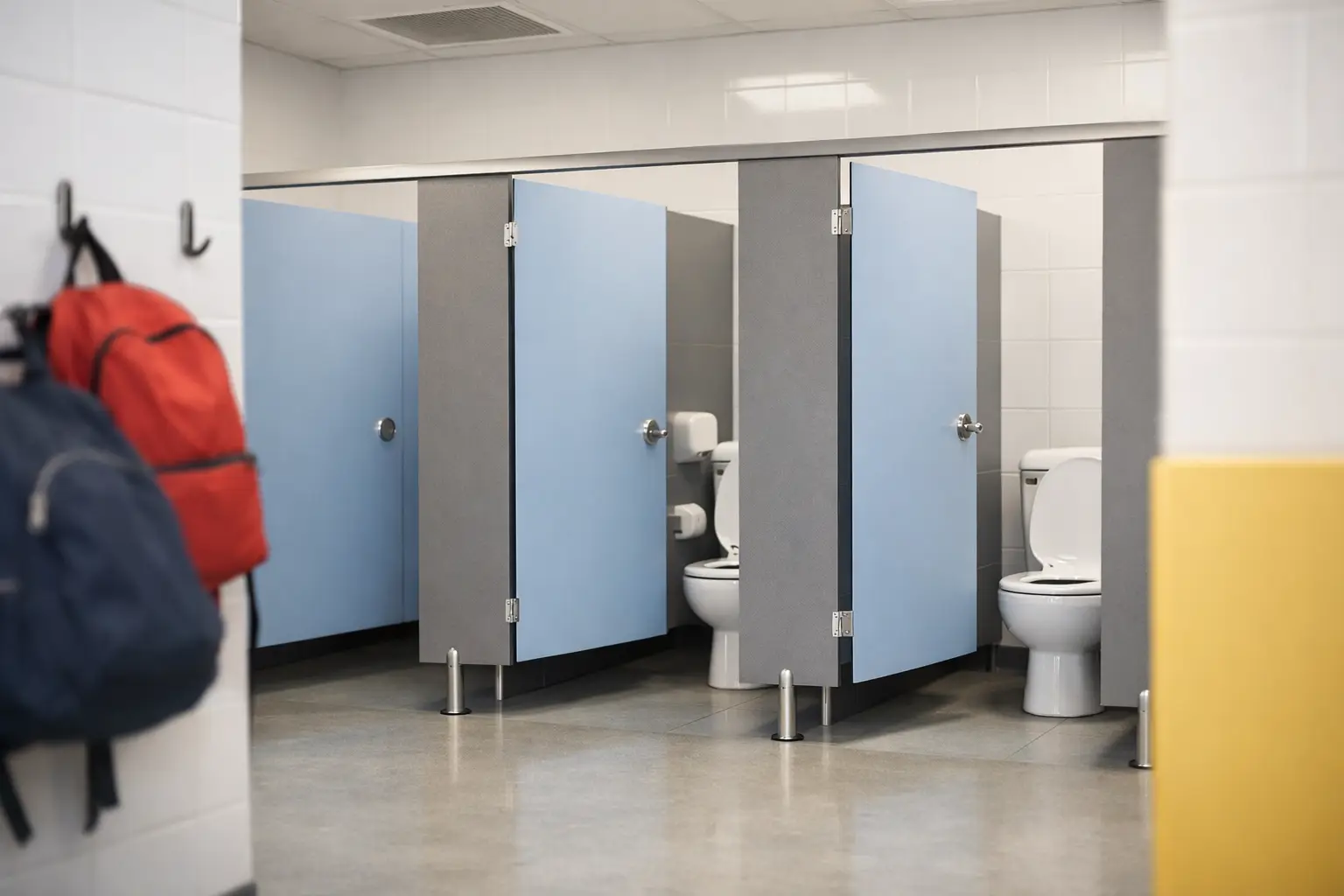
Getting school toilet cubicle regulations right is rarely just about cubicle dimensions. In practice, schools, contractors and specifiers need to balance privacy, supervision, safeguarding, accessibility, durability and maintenance – often within tight footprints and tighter programmes. That is why early specification matters. A washroom that looks acceptable on plan can still fall short once real pupil use, cleaning access and compliance are taken into account.
For education projects, the right answer is not usually a single standard cubicle range applied everywhere. Primary schools, secondary schools, SEND environments and staff areas all have different demands. The regulations and guidance framework points you in the right direction, but the detail of how partitions, doors, ironmongery, clearances and accessible layouts are put together is what determines whether the finished washroom works day to day.
What school toilet cubicle regulations cover
When buyers refer to school toilet cubicle regulations, they are usually talking about a mix of statutory requirements, Building Regulations, accessibility standards, safeguarding expectations and Department for Education guidance. These do not always sit in one neat document, which is why school washroom specification can be more involved than it first appears.
At project level, the main considerations tend to fall into five areas. First, there is suitability for the age group, including cubicle height, door clearance and ease of use. Second, there is privacy, which matters to pupil comfort and to encouraging use. Third, there is accessibility, including wheelchair-accessible and ambulant provision where required. Fourth, there is safety, from finger protection to emergency access. Fifth, there is durability in a high-traffic environment where impact resistance and ease of cleaning directly affect lifecycle cost.
For specifiers, this means regulations should not be treated as a late-stage tick-box exercise. They should shape the layout, product choice and detailing from the start.
Privacy and supervision in school toilet cubicle regulations
One of the more sensitive parts of school washroom design is the balance between privacy and supervision. Schools need pupils to feel secure using the facilities, but they also need layouts that support safeguarding and discourage misuse. That tension affects cubicle height, pedestal gaps, door undercuts, sightlines and the arrangement of shared wash areas.
In younger age groups, lower-height cubicles are often specified so staff can supervise where necessary. In secondary settings, greater privacy is usually expected, and overly exposed layouts can quickly become a source of complaints. There is no universal answer that works across every key stage. What works well in a nursery or infant school may be completely unsuitable in a sixth form block.
This is where experience in education-sector manufacturing helps. A cubicle system for schools should not simply be a cut-down commercial range. It needs to be designed around likely user behaviour, practical supervision requirements and the reality of frequent cleaning.
Height, clearance and age-appropriate design
Cubicle and door heights are normally selected according to the pupil age range. Younger children need easier access, appropriate visual supervision and fittings they can operate confidently. Older pupils generally need increased privacy, with design choices that reduce embarrassment and support regular use.
Hardware also matters more than many expect. Indicator bolts should be simple to use, durable and suitable for the user group. Hinges, headrails and support legs need to withstand repeated heavy use. In schools, the best specification is often the one that reduces avoidable maintenance calls as much as it satisfies the drawing.
Accessibility requirements for school washrooms
Any discussion of school toilet cubicle regulations needs to include accessibility. Mainstream education settings are expected to provide suitable facilities for disabled users, and those requirements should be integrated into the wider washroom design rather than added as an afterthought.
Accessible cubicles need more than extra space. The layout has to allow practical manoeuvring room, sensible door operation, correctly positioned grab rails, suitable sanitaryware and fixtures that can be used safely and independently wherever possible. Door swing, transfer space and the relationship between the WC, basin and accessories all need careful review.
Ambulant provision may also be appropriate depending on the building type and overall layout. In some school projects, the challenge is not understanding that accessible provision is required, but fitting it properly within a constrained footprint. Shrinking clearances to preserve more standard cubicles can create compliance problems and a poor user experience.
For refurbishments, that trade-off can be especially difficult. Existing drainage runs, structural walls and service zones often limit what is possible. In those cases, practical technical advice at design stage can prevent costly revisions later.
Materials, durability and hygiene standards
School washrooms are among the highest-use environments in most public buildings. A compliant design that deteriorates quickly is not a successful specification. Material choice therefore sits close to compliance in practical terms, because damaged cubicles, swollen panels or failing ironmongery can compromise safety, privacy and usability.
For many schools, the priority is a panel construction that stands up to impact, moisture and regular cleaning. Compact grade laminate is often selected for wet or high-abuse areas because of its strength and water resistance, while MFC can still be suitable in lower-risk dry environments where budget is a stronger driver. The right choice depends on how the space will actually be used, how it will be maintained and how long the school expects the fit-out to last.
Easy-clean detailing is equally important. Fewer dirt traps, appropriate floor clearance and well-considered junctions make a real difference to hygiene regimes. In a busy school, cleaners need to work quickly and effectively. Designs that look neat but are awkward to maintain can create long-term operational issues.
Safety points specifiers should not overlook
Safety in school cubicle design goes beyond obvious concerns. Anti-finger-trap details, emergency access capability and stable panel construction all deserve attention. So does the behaviour of hardware under repeated use. A lock that jams occasionally in a low-traffic office washroom becomes a much bigger issue in a primary or secondary school.
Fire performance may also be relevant depending on the specification and wider building requirements. As with any commercial interior product, materials and components should be reviewed against project-specific needs rather than selected on appearance alone.
Another point often overlooked is maintenance access. If a cubicle system is difficult to repair or adjust, minor faults can be left unresolved for longer than they should be. In schools, that quickly affects serviceability. A specification that supports straightforward replacement of fittings and panels can reduce disruption over the life of the washroom.
New build versus refurbishment
New-build school projects usually allow a more efficient approach to compliance because layouts, service zones and accessibility provision can be coordinated from the outset. Refurbishments are different. Existing footprints may be tight, floor levels uneven and drainage positions fixed. That creates pressure to compromise, but this is exactly where the specification needs more discipline, not less.
If the existing layout cannot properly support the required cubicle arrangement, forcing a like-for-like replacement may not be the best route. Replanning the washroom, even modestly, can produce better privacy, easier circulation and more reliable accessible provision. It can also improve installation speed if the cubicle system is manufactured to the project dimensions and supplied with clear technical support.
For contractors and school estates teams working to holiday deadlines, this is not a small issue. Lead times, manufacturing accuracy and the ability to resolve design queries quickly have a direct impact on project delivery.
What to check before you specify
Before a school washroom package is signed off, it is worth checking whether the cubicle design actually matches the user group, not just the room size. The most common problems come from generic specifications applied without enough thought to age range, supervision needs or cleaning regimes.
Review privacy levels, panel and door heights, accessibility layouts, material suitability, hardware durability and maintenance practicality together. If one of those areas is weak, the washroom may still meet part of the brief but fail in use. Good school washroom design is rarely about the cheapest panel or the fastest drawing approval. It is about specifying a system that remains compliant, serviceable and fit for purpose once pupils start using it every day.
For buyers managing education projects, dependable manufacturing support can make that process much easier. With 45 years in the industry, Total Cubicles works with schools, contractors and specifiers to supply UK-manufactured cubicle systems that are built for practical performance as well as compliance.
The safest approach is usually the simplest one – treat school washrooms as a specialist environment, ask the awkward layout questions early, and specify cubicles that will still be doing their job properly long after handover.