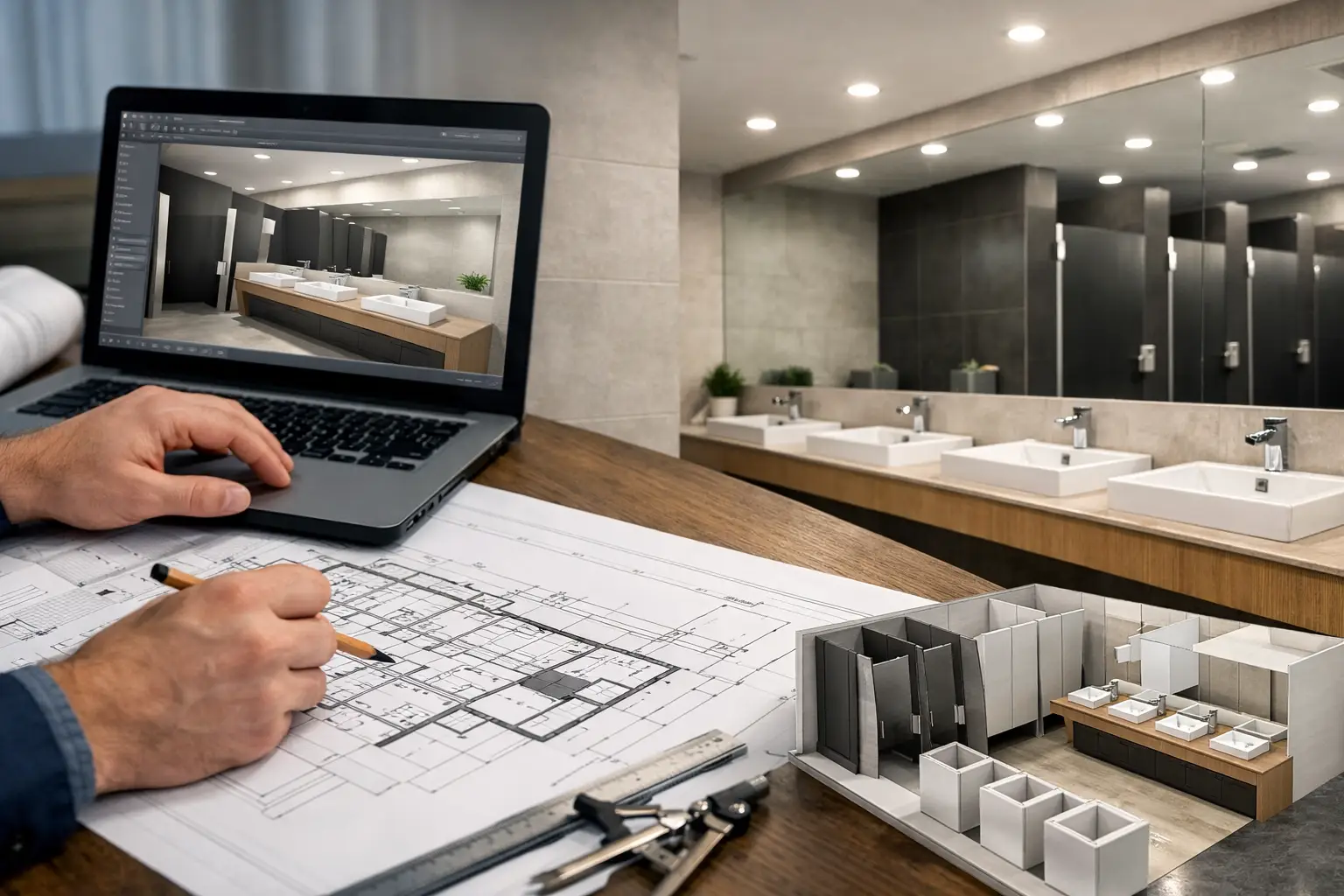
When a washroom scheme reaches the point where dimensions, clearances and product coordination matter, assumptions get expensive. A washroom CAD design service gives buyers, specifiers and contractors a clearer route from outline intent to a workable commercial layout, especially where toilet cubicles, IPS panels, vanity units and accessibility requirements all need to align.
For project teams under pressure, the value is not simply a drawing. It is the ability to test a layout before products are ordered, identify pressure points early and make better decisions on product selection, space use and compliance. In schools, offices, leisure sites, healthcare settings and other public-use buildings, that extra certainty can save time at exactly the point where programmes often tighten.
What a washroom CAD design service actually does
A washroom CAD design service translates room dimensions and project requirements into a coordinated plan. That usually means showing the arrangement of cubicles, duct panelling, vanity units, wall cladding and other fitted elements within the available footprint, while accounting for circulation, access and practical use.
For commercial buyers, this matters because washrooms are rarely specified in isolation. A scheme may need to accommodate standard cubicles, ambulant or accessible layouts, IPS systems, lockers or benching in adjacent changing areas, and finishes that suit the traffic level of the building. On paper, many combinations can appear workable. In a proper CAD layout, the strengths and constraints become much easier to see.
That visibility is especially useful when projects involve refurbishments rather than clean-slate new-builds. Existing room shapes, service positions and structural limitations often dictate more than the client first expects. CAD support helps project teams work with those realities instead of discovering them late.
Why buyers use washroom CAD design service support
Most professional buyers are not looking for drawings for their own sake. They want confidence that the chosen arrangement is practical, suitable for the building type and realistic within budget and programme.
A washroom CAD design service supports that in several ways. First, it reduces guesswork. If a school washroom needs to balance privacy, supervision and durability, the layout can be shaped around those priorities from the outset. If an office refurbishment needs a more premium appearance with modern vanity units and coordinated IPS panelling, the design can reflect that objective without losing sight of space efficiency.
Second, it improves coordination. Commercial washrooms often involve multiple product categories that need to work as one fitted scheme. When cubicles, IPS systems and vanity units are planned together, there is less risk of specification gaps or mismatched assumptions between trades and procurement teams.
Third, it can help speed up decision-making. A clear drawing often settles questions much faster than a written specification alone. Stakeholders can review a proposed arrangement, compare options and move towards approval with fewer revisions.
Early-stage clarity prevents late-stage pressure
The strongest reason to use CAD support is simple – small layout issues have a habit of becoming larger commercial problems. A door swing that clashes with circulation, a vanity run that leaves awkward clearance, or a cubicle arrangement that weakens capacity can all affect the final scheme.
In high-traffic washrooms, every decision has a knock-on effect. Capacity, privacy, cleaning access, durability and user flow are linked. A tighter layout may maximise cubicle count, but it can also create compromises elsewhere. A more generous arrangement may improve user experience and maintenance access, but it depends on the available footprint and budget.
This is where experienced technical support matters. Good CAD design is not just about fitting products into a room. It is about understanding which trade-offs are acceptable for the environment and which ones will create avoidable issues later.
Washroom CAD design service for different sectors
Not every commercial washroom has the same priorities, and a useful CAD service reflects that.
In education, layouts often need to balance robust materials, straightforward supervision and efficient use of space. Junior settings may have different cubicle heights and privacy considerations from secondary schools or colleges. In leisure facilities, wet-use conditions, changing spaces and higher user volumes can push material choice and layout planning in a different direction.
Office schemes tend to place more emphasis on finish, modern presentation and efficient coordination with wider interior design decisions. Healthcare and public sector projects may place greater weight on accessibility, hygiene and long-term durability. In each case, the drawing needs to support the real operational demands of the building, not just the room dimensions.
That sector focus is one of the main benefits of working with a manufacturer that understands specification-led environments. The right layout is rarely a generic one.
Where CAD support adds the most value
CAD input is particularly useful when the project includes several moving parts. Refurbishment schemes are an obvious example because room constraints are often less forgiving. The same applies where buyers need to compare economy, commercial or more design-led cubicle ranges against the same footprint.
It is also valuable on projects where lead times matter. Fast programmes leave less room for uncertainty, so getting the layout right early helps reduce delays in specification approval and product coordination. For buyers managing multiple areas, such as WC washrooms plus changing rooms, the ability to source coordinated products from one UK manufacturer can simplify the process further.
There is also a procurement benefit. Drawings can help internal stakeholders understand what is being purchased and why. That can be useful in schools, local authorities and wider public sector settings where decision-making often involves more than one department.
What to prepare before requesting a washroom CAD design service
The better the starting information, the more useful the design output will be. Accurate dimensions are essential, along with details of any fixed constraints that affect the room. Buyers should also be clear about the intended use of the space, expected traffic levels and whether the priority is economy, appearance, durability or a balance of all three.
If accessibility is part of the brief, that should be raised at the start rather than later in the process. The same applies to preferred product ranges, finish expectations and whether the project includes linked elements such as vanity units, IPS panels or wall cladding.
At this stage, clarity is more helpful than technical jargon. A practical brief with good dimensions and a clear project objective usually leads to a stronger design conversation than an overcomplicated document that still leaves key questions unanswered.
Choosing a supplier with CAD capability
Not all CAD support offers the same value. For commercial buyers, the strongest option is usually a supplier that can combine design assistance with manufacturing knowledge, product range depth and realistic lead-time guidance.
That matters because design decisions do not sit apart from production realities. Material choice, panel sizes, privacy levels, durability requirements and budget all affect what makes sense for the project. A supplier with washroom-specific experience can help shape a layout that works not only on screen, but as part of a practical procurement route.
UK manufacturing can also be a real advantage. It often gives buyers better visibility on quality, faster response times and more confidence when projects need to move quickly. With 45 years in the industry, Total Cubicles understands that buyers are not simply selecting products. They are managing risk across programme, performance and budget.
Washroom CAD design service and specification confidence
A well-prepared drawing will not answer every question on a project, but it does improve the quality of the discussion. It gives architects, contractors, facilities teams and procurement leads something concrete to review, challenge and refine before final decisions are locked in.
That is particularly valuable where washrooms need to perform hard over time. In specification-led environments, durability and compliance are not optional extras. They sit alongside visual finish, capacity and cost. A coordinated CAD layout helps bring those requirements together in a more controlled way.
The result is not simply a better drawing. It is a more informed specification process, with fewer assumptions and stronger alignment between the room, the products and the project brief.
If your washroom scheme needs to move from rough dimensions to a layout you can specify with confidence, CAD support is often the point where the project becomes clearer. The earlier those decisions are tested, the easier it is to keep the scheme practical, coordinated and ready for the next stage.