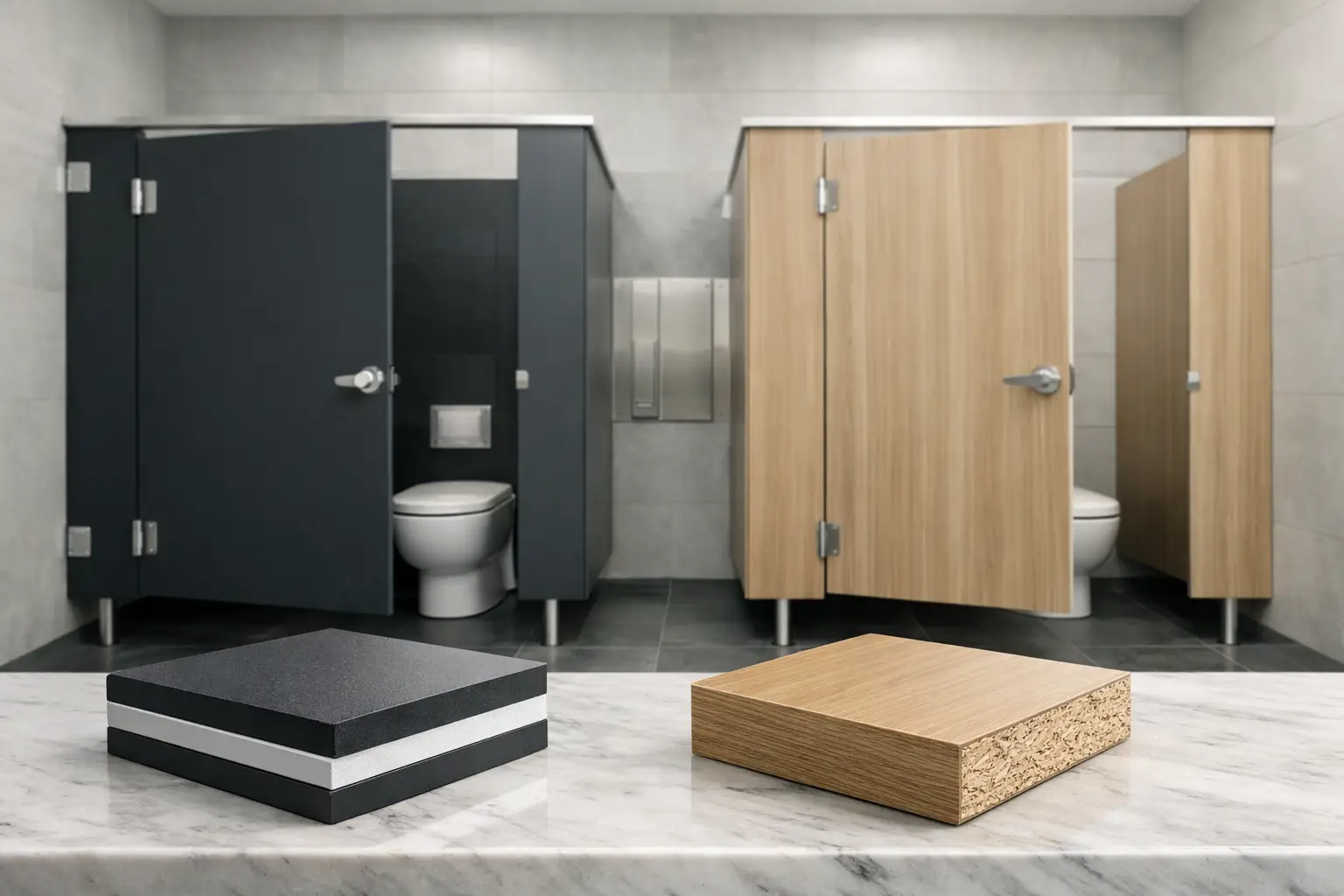
A washroom panel that looks right at handover can become an expensive liability if its core material is not suited to the environment. In the solid grade laminate vs MFC decision, the right answer depends less on appearance and more on how the washroom will be used: the level of moisture, expected footfall, cleaning regime, likelihood of misuse and available budget.
For commercial buyers, this is a specification decision with long-term consequences. Schools, leisure centres and publicly accessible washrooms often demand a different material approach from a lightly used office washroom. Understanding where each board performs best helps protect the budget without under-specifying a high-risk area.
What is solid grade laminate?
Solid grade laminate, often shortened to SGL or compact laminate, is a dense, self-supporting board made from layers of kraft paper impregnated with thermosetting resin. Decorative surface papers are bonded into the board under high heat and pressure, creating a solid-colour core with a hard decorative face.
The material is highly resistant to water and humidity. Unlike board products with a timber-based core, it does not rely on an exposed edge remaining protected from moisture. This makes it a strong choice for shower areas, changing rooms, swimming pool facilities and washrooms where wet clothing, frequent mopping or high humidity are routine.
SGL is also valued for its strength. It stands up well to knocks, impacts and demanding day-to-day use, which is why it is regularly specified for education, leisure and other high-traffic public settings. Panels are commonly supplied at around 13 mm thickness, although the appropriate construction and hardware should always be confirmed against the chosen system and project requirements.
There is a cost consideration. SGL generally carries a higher initial material cost than MFC, so it is most cost-effective where its moisture resistance and durability will genuinely be used. Specifying it in every low-use, dry washroom may not provide the best return on the project budget.
What is MFC?
MFC stands for melamine-faced chipboard. It consists of a chipboard core faced with melamine decorative surfaces, providing an economical, clean and consistent finish for commercial interiors. It is widely used across furniture and washroom applications because it offers a broad choice of colours and practical everyday performance at a competitive price point.
For toilet cubicles in controlled, dry conditions, MFC can be a sensible and professional specification. An office washroom with moderate traffic, effective ventilation and a normal cleaning routine is a typical example. The finished look can coordinate well with vanity units, IPS access panels, lockers and other fitted furniture, helping to create a consistent scheme.
Its limitation is the chipboard core. If water reaches unprotected edges, cut-outs or damaged surfaces, the core can swell and deteriorate. MFC is therefore less suited to areas that remain wet, experience persistent condensation or are likely to receive heavy water exposure. Good housekeeping and prompt attention to damage matter more with this material than they do with SGL.
MFC is often supplied in thicker panels than SGL, frequently around 18 mm. Thickness alone should not be treated as a measure of durability. The board construction, edge treatment, environment and the quality of the complete cubicle system are more relevant than a single dimension.
Solid grade laminate vs MFC in commercial washrooms
The clearest difference between solid grade laminate and MFC is moisture tolerance. SGL is designed to cope with wet, humid and hard-working environments. MFC performs best where the washroom is dry in normal use and water exposure can be controlled.
Traffic is the next consideration. A small staff washroom may see predictable use from a limited group of people. A school, transport hub, sports facility or visitor attraction can experience high volumes, more forceful use and a greater chance of accidental or deliberate damage. SGL offers greater reassurance in these demanding circumstances, particularly when lifecycle value is more important than the lowest upfront spend.
Cleaning regimes should also influence the choice. Frequent cleaning is essential in public washrooms, but repeated wet cleaning and standing water place greater demands on panel materials. SGL is well suited to intensive cleaning environments. MFC remains a credible option where cleaners can avoid excessive water saturation and the washroom is maintained as a dry space.
Aesthetic requirements may pull the decision in either direction. Both materials are available in a range of colours, woodgrains and contemporary finishes. MFC can be particularly useful where the washroom scheme needs to match surrounding commercial furniture. SGL delivers a crisp, durable finish and is often selected for modern, practical spaces where resilience is the priority.
Match the material to the sector
There is no universal winner because the risk profile changes from one building to another. The following scenarios provide a useful starting point for specification.
Schools and colleges
Education projects vary considerably. A staff washroom or low-use sixth-form area may be suitable for MFC where moisture is controlled. However, pupil washrooms usually require more consideration of footfall, impact resistance and cleaning frequency. SGL is often the more dependable choice for busy areas, especially where long service life and reduced disruption are key priorities.
Offices and commercial workplaces
MFC is commonly a strong fit for standard office washrooms. It provides an attractive finish at a measured cost and performs well in a managed, dry environment. For corporate washrooms with showers, changing facilities or unusually high visitor numbers, SGL may be the more appropriate option.
Leisure, changing and wet areas
Leisure centres, gyms, poolside facilities and changing rooms are where SGL comes into its own. These spaces face humidity, wet floors, damp clothing and sustained use throughout the day. Selecting a water-resistant compact laminate panel helps reduce the material risks associated with these conditions.
Healthcare and public sector buildings
Usage patterns are particularly important in healthcare and public buildings. Some staff-only areas may be appropriate for MFC, while public washrooms, changing spaces and facilities with intensive cleaning routines may justify SGL. The decision should reflect the specific room, not simply the building type.
Do not assess panels in isolation
A cubicle material is only one part of the specification. Door and partition layout, supporting framework, fittings, edge detailing, ventilation, cleaning access and accessibility requirements all affect the finished performance of a washroom.
For example, a well-chosen SGL panel can still be the wrong solution if the layout does not support the user group or if access requirements have not been considered early enough. Equally, a carefully planned MFC system can offer excellent value in the right low-moisture setting. Material selection should sit within a wider review of the room’s use, maintenance plan and expected lifespan.
Compliance should be considered at this stage too. Accessible washrooms, ambulant facilities and changing provision may need specific clearances, door arrangements and hardware. Fire performance requirements can also vary by project. Product data should be checked against the relevant building, client and sector guidance rather than assumed from a generic panel description.
Choosing on whole-life value, not price alone
The lower purchase cost of MFC can make it the right commercial choice for dry, lower-risk washrooms. It allows budgets to be directed towards other priorities while still achieving a smart and durable result for the environment.
SGL can offer better whole-life value where moisture, traffic and potential damage are high. Its higher initial price may be justified by greater resistance to deterioration and a longer useful service period. This is particularly relevant on projects where future closures, replacement work and disruption would be costly.
A practical specification can also use both materials across one site. MFC may be selected for office washrooms, while SGL is reserved for showers, changing rooms and heavily used public facilities. This targeted approach avoids paying for a premium material where it is not needed, without compromising the areas that need it most.
Make the decision before finishes are finalised
Colours and finishes are often the most visible part of a washroom scheme, but they should follow the material decision rather than lead it. Begin with the environment: how wet it gets, who uses it, how often it is cleaned and how long it needs to perform. Then select the board type that can meet those conditions with confidence.
For specification-led projects, early technical discussion can prevent late changes, protect programme certainty and ensure coordinated cubicles, vanities, IPS panels and changing-room furniture are suited to the same level of use. A clear brief produces a more reliable result than choosing on appearance alone.