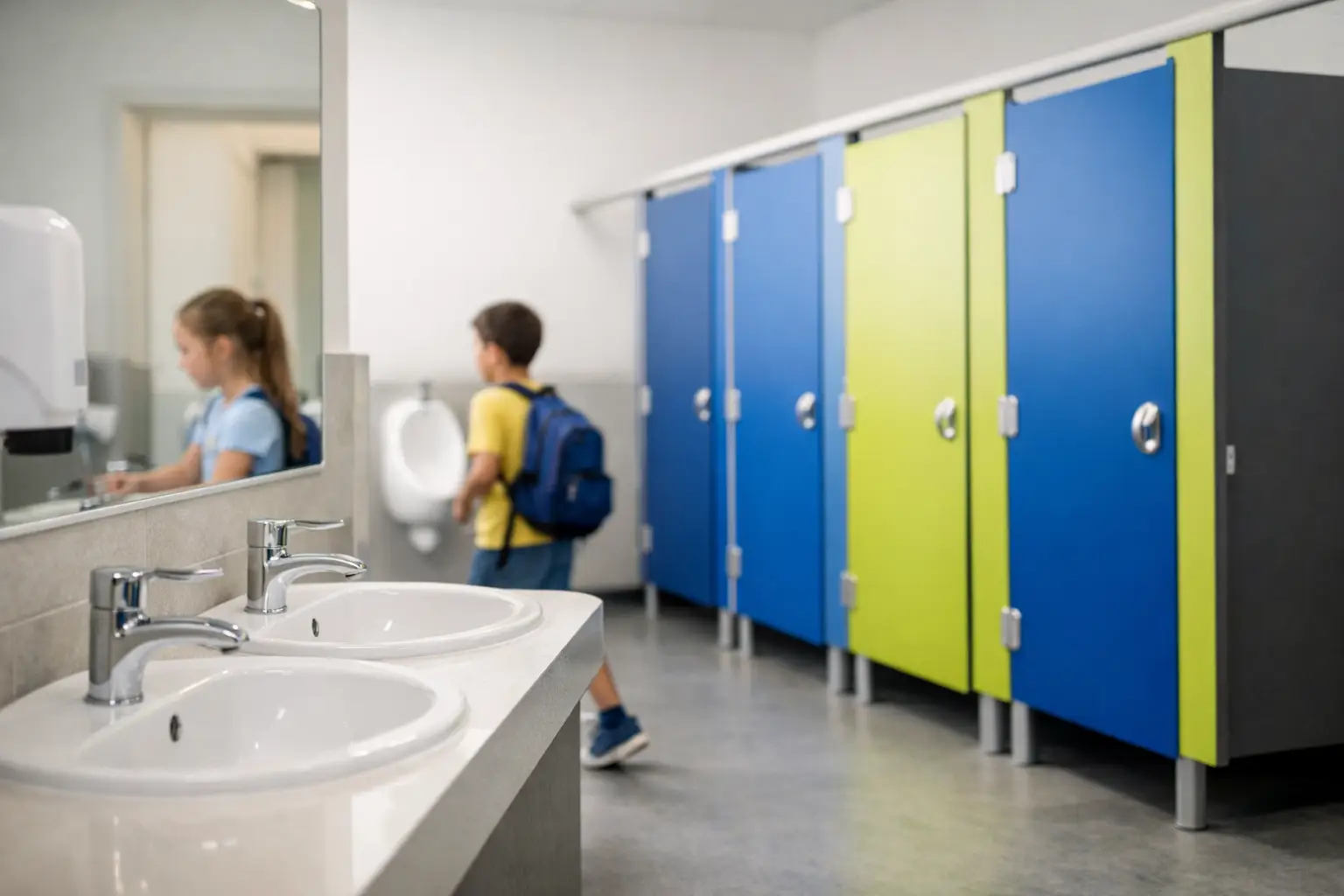
A school washroom that looks acceptable on handover can still fail within months if the layout creates queues, the cubicles feel exposed, or the finishes cannot cope with daily traffic. That is why knowing how to design school washrooms properly matters at the specification stage, not once complaints start arriving from site teams, staff or pupils.
For schools, the brief is rarely just about fitting in enough WCs and basins. It is about balancing safeguarding, privacy, durability, cleaning efficiency, accessibility and budget. Primary settings, secondary schools and sixth form environments all use washrooms differently, so the right answer is not one standard layout repeated across every block.
How to design school washrooms around actual use
The strongest school washroom schemes start with behaviour, not just dimensions. A primary school washroom often needs strong staff visibility, simple navigation and surfaces that are easy to clean quickly during the day. A secondary school washroom may need greater privacy, better flow at lesson-change times and a more robust specification to cope with heavier use.
This is where many projects become too generic. A washroom near a dining hall, sports area or main circulation route will see a different pattern of use from one attached to a classroom wing. Peak demand matters. If pupils all arrive within a short changeover window, a layout that works on paper can still create congestion around entrances, vanity areas and hand-drying zones.
A practical design approach starts by asking who will use the space, when they will use it, and how supervision needs to work. Once those answers are clear, cubicle arrangement, screening, vanity positioning and material choice become much easier to define.
Start with layout, circulation and supervision
Good circulation is one of the main differences between a washroom that performs well and one that causes daily frustration. Pupils should be able to enter, wash hands and leave without crossing awkwardly into cubicle queues. That sounds simple, but in compact school footprints it takes careful planning.
Entrances need enough space to avoid bunching, particularly at busy periods. Basin and hand-washing areas should sit where users can move through them naturally rather than doubling back. If privacy is needed near the entrance, modesty screens can help, but they should not create blind spots or a cramped feel.
Supervision is another area where balance matters. In younger age groups, schools often want layouts that support passive oversight without compromising dignity. In older pupil environments, the emphasis shifts towards privacy and calm use. The design response should reflect that difference rather than applying one approach across all age ranges.
Where projects involve refurbishment, inherited room shapes can limit options. In those cases, a coordinated washroom package becomes useful because cubicles, IPS systems, vanity units and wall finishes can be considered together, helping the room work harder within the available footprint.
Privacy is not optional
If pupils avoid using a washroom because it feels exposed, the design has failed regardless of how durable the products are. Privacy has become a central consideration in school projects, and rightly so.
That does not always mean specifying the same cubicle style in every setting. Younger pupils may benefit from lower-height arrangements that support staff awareness, while secondary and sixth form environments often need higher levels of enclosure. The correct specification depends on safeguarding policy, pupil age and the school’s operational preferences.
Privacy also extends beyond the cubicle itself. Sightlines from entrances, mirrors, vanity runs and hand-drying points need attention. A washroom can technically include private cubicles yet still feel uncomfortable if users are immediately visible from busy corridors or shared lobby areas.
This is why the details matter. Door clearance, panel height, modesty screening and room zoning all contribute to whether pupils actually feel comfortable using the facility.
Choose materials for heavy school traffic
School washrooms are high-use, high-contact environments. Materials need to withstand knocks, moisture, frequent cleaning and the general wear that comes with term-time use. A finish that looks cost-effective initially can become expensive if it marks easily, swells in damp conditions or dates quickly.
For cubicles, durability and suitability for the age group should guide the choice. In some schools, an economy range may meet budget and performance needs in lower-intensity areas. In others, a more heavy-duty commercial or education-specific specification is the safer long-term decision. It depends on traffic levels, supervision, cleaning regimes and expected lifespan.
Wall protection is just as important. Wall cladding can reduce maintenance pressure and help preserve appearance in splash-prone areas. Vanity units should be selected with both resilience and cleaning practicality in mind. The aim is a room that keeps its standard over time, not one that only looks right in project photography.
Buyers also need consistency across the package. Coordinated products reduce the risk of mismatched finishes and help create a more considered result, particularly where schools want a clear visual identity across multiple blocks or phases.
Accessibility should shape the design from the outset
Accessible provision should never be treated as an afterthought or an isolated room added late in the process. It needs to be planned as part of the core washroom strategy, with enough space, suitable layouts and products that support inclusive use.
In school environments, accessibility can involve a range of user needs, from wheelchair access to assisted use and age-specific requirements. The right solution depends on the building type and who is expected to use the facilities, including staff and visitors as well as pupils.
Compliance matters here, but so does practicality. A room can satisfy basic dimensional requirements and still be awkward to use if fittings are poorly positioned or circulation is compromised. Early coordination helps avoid those issues and gives specifiers more confidence that the final arrangement will work in real conditions.
For public sector and education projects, this is one of the clearest reasons to involve an experienced manufacturer early. Technical consultation and CAD support can save time and reduce design uncertainty when accessible, standard and staff washrooms all need to work as a coherent package.
Hygiene and maintenance affect long-term value
School buyers are rarely looking at day-one appearance alone. They are thinking about cleaning time, maintenance demands and how often products will need replacement. Washroom design should support that reality.
Simple forms tend to perform better than overcomplicated detailing. Surfaces that wipe down quickly, boxed-in services via suitable IPS solutions, and durable panels that hold their finish all help reduce operational burden. The easier a washroom is to keep clean and presentable, the more likely standards will stay high across the school year.
There is also a budget trade-off to consider. A lower initial outlay can be attractive, especially on multi-area refurbishments, but if products need more frequent repair or replacement, overall value drops. For busy schools, long-term durability often justifies a stronger specification.
That said, not every room requires the same level of product. A practical, project-led approach is to match specification to use. Main pupil washrooms, changing-adjacent areas and high-traffic circulation points may need tougher finishes than lower-demand staff facilities.
Design choices should reflect age group and setting
One of the most common mistakes in education projects is treating all school washrooms as a single category. Primary, secondary and SEND settings can have very different functional needs.
Primary washrooms often benefit from bright, welcoming finishes, straightforward layouts and age-appropriate dimensions. The design should support independence while still aligning with supervision and safeguarding expectations. Secondary settings usually need a more mature appearance, stronger privacy and products selected for higher traffic and more demanding use.
In specialist environments, the brief may require greater flexibility, more generous circulation or adapted solutions that suit the needs of individual users. The key point is that school washroom design is not one-size-fits-all. Product range, layout and finish selection should respond to the setting rather than forcing the setting to fit a standard package.
Why specification support makes the process easier
Knowing how to design school washrooms is partly about choosing the right products, but it is also about reducing risk in the decision-making process. Commercial buyers, architects and school estate teams need confidence that the scheme is suitable, compliant and realistic against programme demands.
That is where working with a UK manufacturer with education experience can add practical value. A supplier that can support quotations, coordinate cubicles with IPS panels, vanity units and wall cladding, and provide CAD design input helps streamline specification. It also gives buyers a clearer route from concept to approved scheme, particularly when lead times are tight.
For schools and contractors managing multiple priorities, responsiveness matters nearly as much as product quality. The right support helps avoid unnecessary revisions, protects project timelines and makes it easier to deliver a washroom that performs properly once in use.
A well-designed school washroom should feel straightforward to the people using it every day. That usually means the hard thinking has already happened behind the scenes – in the layout, the specification and the decisions made early enough to get them right.