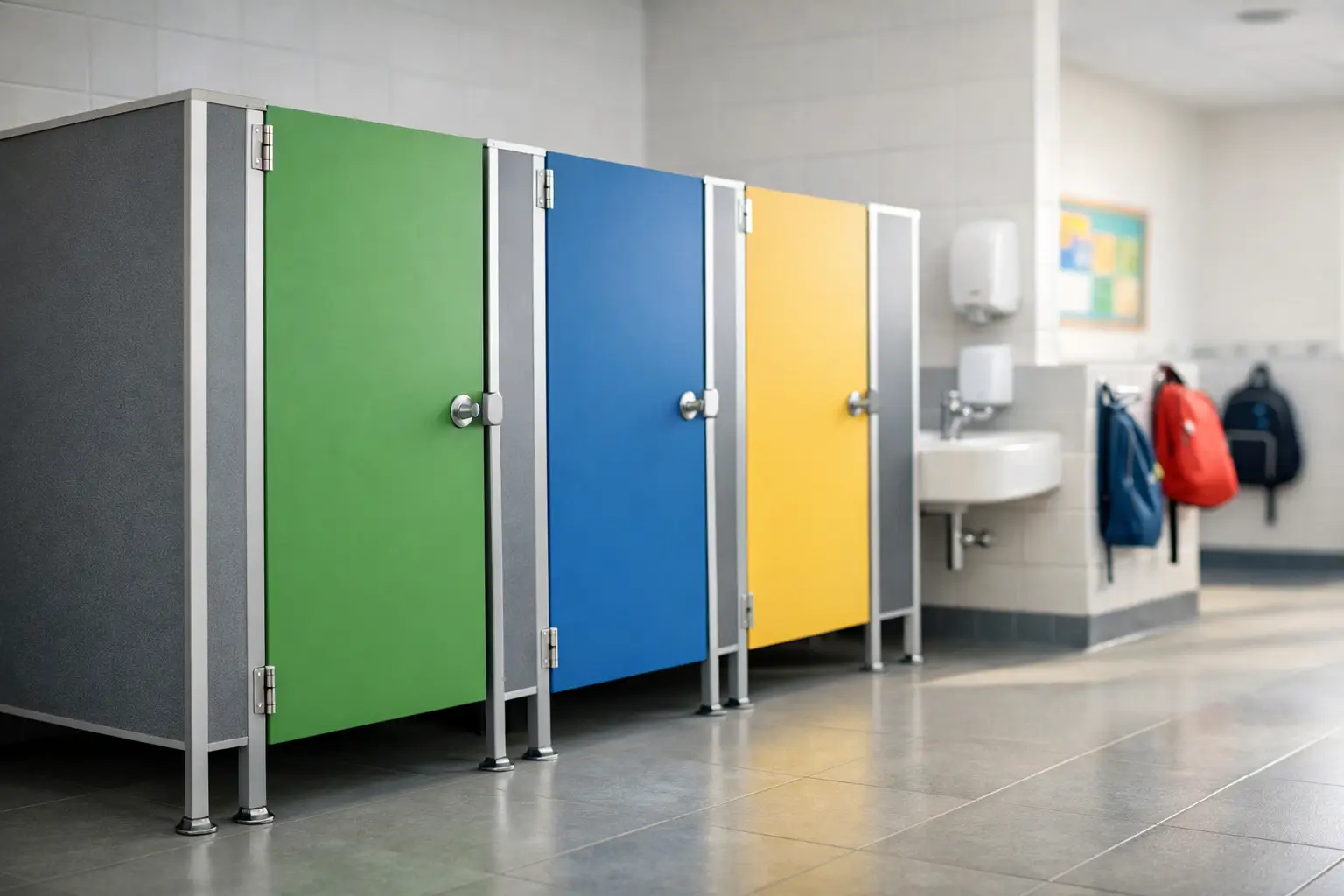
A school washroom is judged quickly. Pupils notice privacy, staff notice durability, and estates teams notice how well the specification stands up to daily use. That is why school washroom cubicles need more thought than a standard commercial washroom product. In education settings, the right choice supports safeguarding, cleanliness, supervision, accessibility and long-term value.
For school business managers, contractors and specifiers, the challenge is rarely just picking a finish. It is balancing age group, traffic levels, budget, compliance requirements and programme pressures without compromising product life. A cubicle range that works well in an office may not be right for a primary school, and a specification that suits a sixth form block may be excessive for a low-traffic staff area.
What makes school washroom cubicles different
Education washrooms are used hard and judged constantly. Doors, partitions and ironmongery are opened, closed and knocked throughout the day. Cleaning is frequent, moisture levels can be high, and appearance still matters because tired washrooms can affect how a whole building is perceived.
School washroom cubicles also have a more specific brief than many other sectors. Younger pupils often need a design that supports staff oversight and straightforward use. Older students expect better privacy and a more mature finish. In SEN environments, dimensions, ease of use and layout decisions may require even closer attention. The best specification starts with who will use the space, not just what fits the drawing.
Specifying school washroom cubicles by age group
Age suitability is one of the first decisions to get right. In primary settings, lower heights and practical sightlines are often preferred. These help create a washroom that feels manageable for younger children while still allowing appropriate supervision. Anti-finger-trap details and easy-to-operate locks can also be more relevant here than in other sectors.
In secondary schools, privacy usually becomes a stronger priority. Pupils want a washroom that feels more secure and less exposed, so increased door and partition heights may be appropriate. At the same time, the product still needs to withstand heavy daily traffic and routine cleaning without becoming a maintenance issue after a short period.
Sixth forms and colleges often sit closer to commercial expectations. A more refined finish may be desirable, particularly in newer campuses where washrooms form part of a wider design standard. Even then, durability should stay central. A smart-looking panel is only a good choice if it continues to perform in a busy education environment.
Privacy and supervision need to work together
This is where specification needs balance. Full privacy can be the right choice in some areas, but in many schools there is still a need to support safeguarding and deter misuse. That does not mean defaulting to the most basic arrangement. It means selecting cubicle heights, floor clearance and overall layout with the building’s management needs in mind.
A practical manufacturer will usually help buyers weigh these variables early, before the project reaches a point where changes become awkward. Optional 3D CAD support can be particularly useful here, giving project teams more confidence that the washroom will work as intended.
Materials matter more than many buyers expect
The biggest cost difference between cubicle ranges is often tied to material performance. For school washroom cubicles, that matters because education environments can expose weak points very quickly.
MFC can be a sensible option for dry areas and tighter budgets, especially where a good appearance is required without moving into a higher-cost specification. It offers broad design choice and can work well in the right setting. However, if the washroom is likely to see heavier moisture exposure or more demanding use, compact grade laminate may offer better long-term value. It is more resistant to water, impact and wear, which can reduce premature replacement in high-traffic pupil areas.
There is no single right answer for every school. A budget-led refurbishment in a low-moisture internal block may justify one approach, while a leisure-linked changing area or a wet-prone pupil washroom may justify another. Good specification is not about choosing the most expensive board every time. It is about matching material to risk, usage and expected lifespan.
Hardware and fittings should not be an afterthought
Panels attract attention, but hardware often determines day-to-day performance. Hinges, indicators, support legs and headrails all take repeated use. If these details are weak, cubicles can start to feel tired long before the board material reaches the end of its life.
For schools, it makes sense to look for hard-wearing, commercial-grade fittings designed for frequent use. This can protect the overall investment and reduce disruption caused by avoidable replacements. Procurement teams focused only on the panel finish sometimes miss this point.
Compliance, accessibility and practical layout
School washroom cubicles must sit within a wider compliance picture. Accessibility requirements, circulation space, cubicle dimensions and the needs of different users all need to be considered at specification stage. In many projects, this extends beyond the cubicles themselves to vanity units, IPS panels, wall protection and coordinated washroom finishes.
Accessible provision should never feel tacked on. It needs to be designed as part of the broader washroom scheme so the space works properly for users and supports clear, compliant planning. In education settings, that may also mean considering how separate pupil, staff and visitor facilities are treated across the building.
Layout has a direct effect on usability. A technically compliant washroom can still be awkward if movement is restricted, privacy lines are poor or cleaning access is compromised. That is why a project-focused approach adds value. Buyers are not simply ordering panels; they are trying to create a washroom that functions reliably every day.
Appearance still counts in education projects
Function comes first, but aesthetics should not be dismissed. A well-finished washroom supports the overall standard of a school and can help create a cleaner, more cared-for environment. Colour choice, coordinated materials and a cubicle style suited to the age group all play a part.
For younger pupils, brighter tones may suit the wider scheme. For secondary and sixth form settings, more neutral or contemporary finishes may feel more appropriate. The key is choosing a look that aligns with the building while still using materials and details made for commercial use.
Bespoke printed options may also be relevant in selected projects, particularly where a school wants to support wayfinding, branding or a more distinctive interior. As with any tailored feature, the question should be whether it adds practical value to the setting rather than simply visual novelty.
Lead times and supply confidence affect project outcomes
Education projects often run to tight holiday windows and fixed handover dates. That makes manufacturing responsiveness a real specification factor, not just a purchasing detail. Buyers need confidence that products can be produced to the agreed standard and delivered within programme.
This is one reason many procurement teams prefer working with a UK manufacturer. Clear communication, shorter supply chains and practical consultation support can reduce uncertainty when timings are tight. Fast lead times are helpful, but only if they come with technical certainty and dependable product quality.
A broader product offer can also simplify procurement. When cubicles, IPS panels, vanity units, wall cladding and related washroom items can be sourced together, it becomes easier to coordinate finishes and maintain project momentum. For schools and public sector buyers, that joined-up approach often saves time as well as administration.
How to judge value, not just cost
The lowest quote is not always the lowest cost over the life of the washroom. If a cubicle range struggles with moisture, impact or cleaning chemicals, the savings can disappear quickly. Equally, overspecifying every school washroom can stretch budgets unnecessarily where a simpler solution would have performed perfectly well.
A better approach is to look at value in context. How many users will the washroom serve? What level of wear is realistic? Is this a premium new-build, a phased refurbishment or a time-sensitive upgrade? Does the space need to prioritise budget control, visual finish, moisture resistance or all three?
That is where an experienced manufacturer adds more than supply. With the right consultation, buyers can compare ranges properly and select a product that suits the actual brief. Total Cubicles supports this process with UK manufacturing, free quotations and specification guidance shaped around project requirements rather than off-the-shelf assumptions.
The most effective school washroom cubicles are not chosen by finish alone. They are selected because they fit the pupils, the building and the pressures of the project. Get that decision right, and the washroom will keep doing its job long after the handover date has passed.