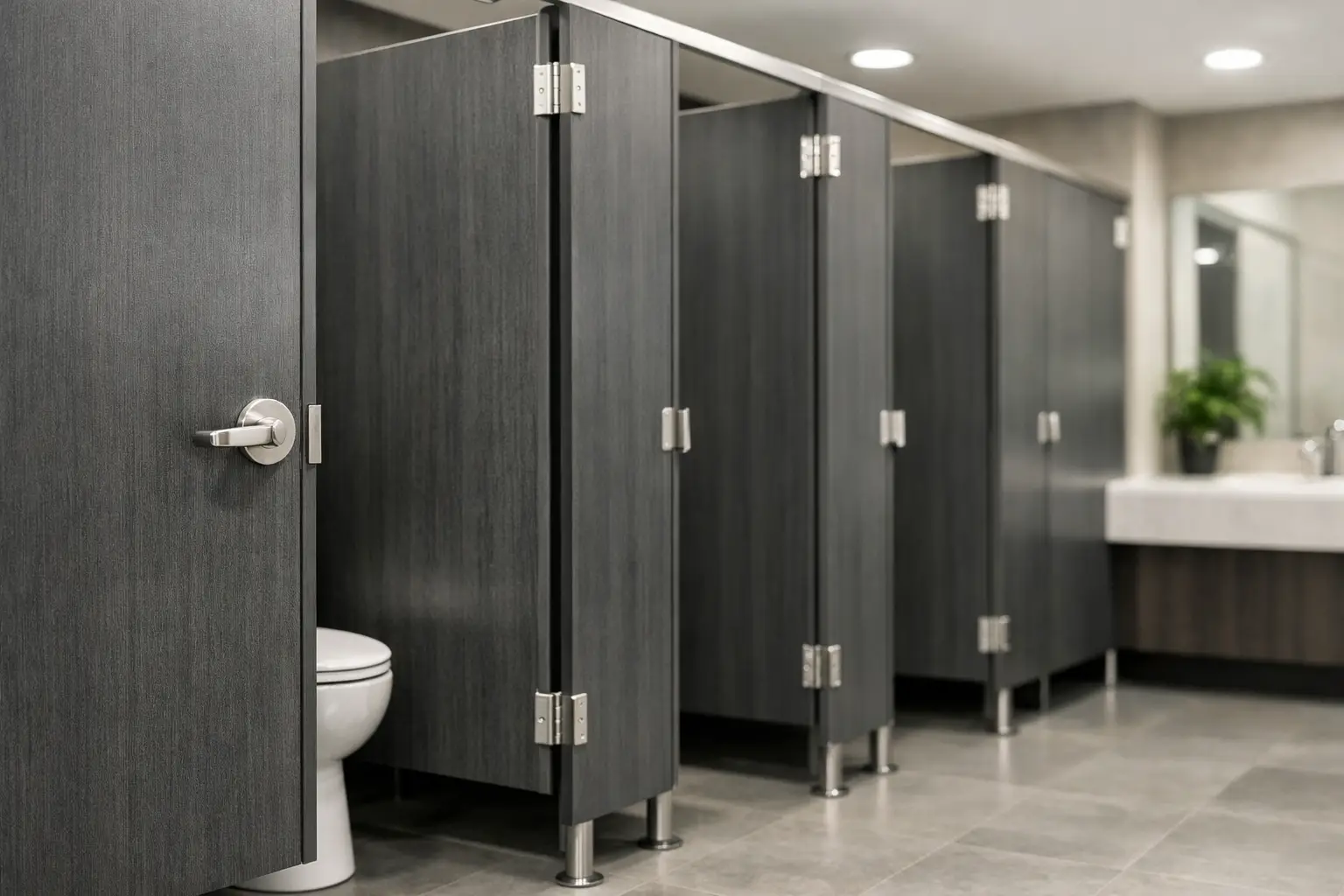
A compact laminate cubicle review is rarely about appearance alone. For most commercial buyers, the real question is whether the material will hold up under daily pressure – heavy traffic, repeated cleaning, moisture, impact and the usual wear that quickly exposes weaker specifications.
That is why compact laminate remains one of the most widely specified choices for demanding washroom environments. It is not the cheapest board on the market, and it is not always the right answer for every budget. But where durability, hygiene and long-term value matter, it deserves serious attention.
What this compact laminate cubicle review should answer
If you are comparing cubicle materials for a school refurbishment, office washroom upgrade, leisure facility or public sector project, compact laminate usually enters the conversation quite early. It has a strong reputation, but reputation alone is not enough when you are balancing performance, compliance, appearance and programme pressure.
In practical terms, compact laminate is a high-density solid grade material manufactured by compressing layers of kraft paper with thermosetting resins under high pressure. The result is a self-supporting panel with a dense core and a hard-wearing decorative face. That construction is what gives it its strength in commercial settings.
The key benefit is consistency. In environments where panels are exposed to moisture, knocks, abrasion and frequent cleaning, compact laminate offers a level of resilience that lighter board products often struggle to maintain over time.
Where compact laminate performs best
Compact laminate is particularly well suited to washrooms with heavy, continuous use. Education is a clear example. In primary and secondary schools, cubicles need to cope with regular impact, fast cleaning routines and a user group that is not always gentle with surfaces. Compact laminate copes well because the material is solid through its thickness rather than relying on a decorative surface over a more vulnerable core.
Leisure and changing environments are another strong fit. In wet or humid spaces, moisture resistance becomes a major factor. Compact laminate does not react in the same way as melamine-faced board products when exposed to regular humidity or splashing. That makes it a dependable choice for swimming pools, sports centres and shower-adjacent cubicle areas.
It also suits offices, healthcare settings and public-use buildings where a cleaner, longer-lasting finish is required. In these projects, the decision is often less about surviving extreme abuse and more about reducing maintenance issues while keeping the washroom looking presentable for longer.
Durability in real commercial use
The main reason specifiers move towards compact laminate is straightforward – it is built for harder use. Edges are solid, surfaces are impact resistant and the material is far less vulnerable to swelling from moisture ingress than standard MFC or MDF-based alternatives.
That does not mean it is indestructible. Hardware, layout and general specification still matter. A poor cubicle design can create weak points regardless of board type. But if the question is whether compact laminate offers a stronger starting point for high-traffic commercial washrooms, the answer is yes.
Over the life of the washroom, this matters more than the initial brochure comparison sometimes suggests. Panels that retain their shape, finish and structural integrity tend to reduce replacement cycles and help maintain a more professional appearance in front-of-house and public-facing environments.
Hygiene and cleaning standards
Hygiene is another area where compact laminate scores well. Its non-porous surface helps support regular cleaning, and the dense board construction avoids some of the deterioration risks seen in less suitable materials when exposed to water and cleaning products over time.
For healthcare, education and public sector buyers, this is not just a housekeeping point. It affects ongoing maintenance expectations and the practical lifespan of the cubicle system. A material that can be cleaned frequently without rapid visual decline offers a clear operational benefit.
Colour and finish choice also play a part. Lighter shades can help create a cleaner visual impression, while darker tones may disguise minor scuffs better in high-use settings. The right answer depends on the environment, user profile and cleaning regime.
Compact laminate cubicle review: cost versus value
The most common hesitation is cost. Compact laminate is typically positioned above entry-level cubicle materials on price, and that can make initial comparisons look unfavourable if the project is being judged on supply cost alone.
That is only part of the picture. In many commercial settings, value is measured over years rather than at order stage. If a lower-cost material is more likely to chip, swell, mark or require earlier replacement, the apparent saving can narrow quickly. Procurement teams and facilities managers are often better served by looking at whole-life performance, especially in high-traffic or wet environments.
That said, compact laminate is not automatically the best option for every project. In a low-use office washroom with tight budget constraints and a dry environment, a more economical specification may still be appropriate. The right decision depends on usage intensity, expected lifespan, maintenance priorities and the standard of finish required.
Appearance and design flexibility
Compact laminate is a practical material, but it is not limited to purely functional schemes. Modern ranges offer a broad selection of colours, woodgrains and contemporary finishes, making it suitable for projects where presentation matters alongside performance.
This is useful in commercial offices, hospitality-adjacent spaces and premium public facilities where the washroom contributes to the wider perception of the building. A cubicle range has to perform, but it also needs to sit comfortably within the overall interior scheme.
Because compact laminate has a solid, high-quality feel, it tends to support a more substantial finish than lighter board alternatives. For many buyers, that visual and tactile difference is part of the justification.
Points buyers should weigh carefully
No material is universally correct, and a balanced compact laminate cubicle review should be clear about the trade-offs. The first is budget. If capital cost is the dominant factor, compact laminate may feel difficult to justify in lower-demand environments.
The second is over-specification. Some projects simply do not need the highest level of moisture resistance or impact durability. If a washroom serves a small staff area with limited use, a mid-range product may meet the brief perfectly well.
The third is specification alignment. Compact laminate panels can perform excellently, but the full cubicle system still needs to suit the sector, user group and expected duty level. Privacy level, accessibility requirements, compliance guidance and coordinated washroom elements all need to be considered as part of the wider package.
Who should choose compact laminate?
For schools, colleges, leisure centres, healthcare settings and busy public washrooms, compact laminate is often the safer long-term choice. It suits buyers who need confidence that the cubicles will stand up to regular use and still present well after repeated cleaning cycles.
It is also a sensible option for projects where moisture exposure is likely or where maintenance teams want to avoid the familiar issues that arise when lower-grade materials begin to fail at edges, corners or fixings.
For lower-traffic office environments or cost-sensitive refurbishments, it may still be worth reviewing alternative ranges. Good specification is about matching the product to the building, not applying the same answer to every scheme.
Final view on compact laminate
If the brief calls for durability, hygiene and dependable performance, compact laminate remains one of the strongest commercial cubicle materials available. Its higher upfront cost is real, but so is its ability to withstand the demands that quickly shorten the life of less capable systems.
For professional buyers, the decision usually comes down to risk. If the washroom is likely to experience heavy use, wet conditions or a demanding cleaning regime, compact laminate reduces compromise. And when a project needs a balance of UK manufacturing confidence, practical specification support and a product range suited to commercial use, that is where an experienced supplier such as Total Cubicles can add real value from the start.
The best cubicle material is not the one with the lowest headline price – it is the one that stays fit for purpose when the building is fully occupied and the washroom is in daily use.