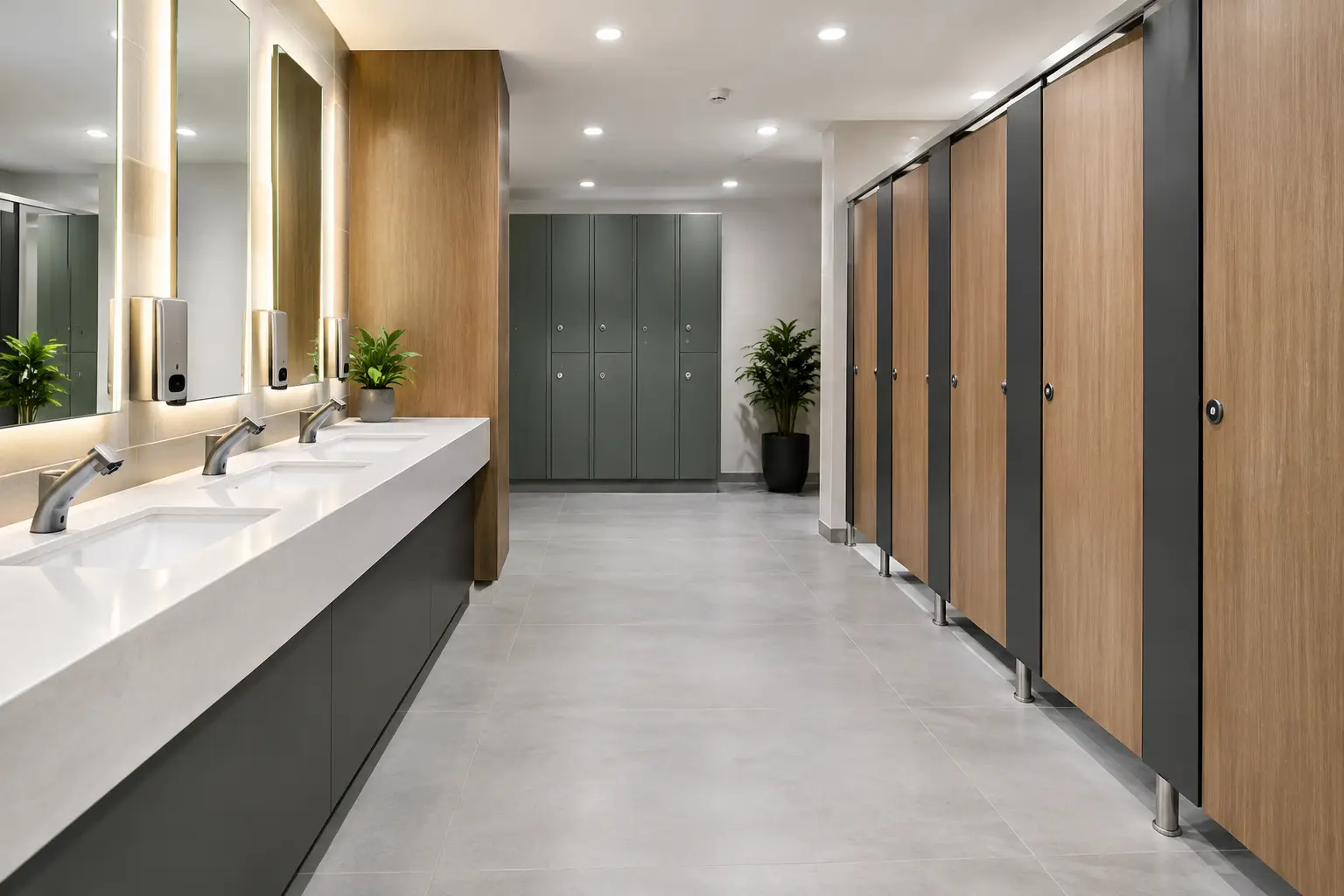
A washroom can be well finished, compliant on paper and still create avoidable contact points. The most useful touchless washroom trends are therefore not about adding sensors everywhere. They are about reducing unnecessary hand contact while keeping the room intuitive, accessible, serviceable and suitable for the level of use it will receive.
For schools, offices, leisure facilities, healthcare environments and public buildings, the question is no longer simply whether touch-free fittings are desirable. It is how they affect the wider washroom specification: IPS access, vanity design, cubicle layout, cleaning routines, power provision and long-term maintenance. A successful scheme treats these as connected decisions rather than separate product choices.
Touchless washroom trends shaping specifications
The strongest trend is towards coordinated touch-free journeys. A user may enter through an open lobby or low-contact door arrangement, use a sensor-operated tap and soap dispenser, activate a hands-free flush, then dry their hands without touching a dispenser, button or waste flap. Each individual feature is familiar. The value comes from making the sequence clear and dependable.
This matters most in high-footfall settings where facilities teams are managing cleaning expectations alongside durability and running costs. Reducing commonly touched surfaces can support hygiene procedures and improve user confidence, particularly where washrooms are shared by large numbers of people throughout the day.
However, touchless technology should not be specified as a blanket rule. A busy secondary school washroom has different risks, user behaviour and supervision requirements from an office washroom or a changing area in a leisure centre. The right approach depends on traffic levels, the age and needs of users, available maintenance resource and the building’s existing services.
Sensor taps are becoming a standard consideration
Sensor-operated taps remain the most widely adopted touch-free fitting. They can reduce contact with tap handles and help manage water use, provided the detection range and run time are set correctly. In a commercial installation, the tap must respond reliably to a range of users without running unnecessarily when someone passes the basin.
The specification needs to account for more than the tap body. Sensor taps may require mains power, batteries or a combination of both. Mains-powered systems can reduce the burden of battery replacement, but may need earlier coordination with electrical design. Battery-powered fittings can simplify refurbishment work where access to power is limited, although a planned replacement schedule is essential.
Basin and vanity selection also affects performance. A poorly positioned spout, dark or highly reflective basin finish, or insufficient clearance around the sensor can create inconsistent activation. Mock-ups and technical checks are worthwhile on larger projects, especially where bespoke vanity units or solid surface basins are being considered.
Touch-free flushing requires service access
Sensor flushing can reduce contact at the WC while presenting a cleaner, more contemporary appearance. It is increasingly specified in premium office, healthcare and public-use schemes, but it must remain accessible for maintenance. Concealed cisterns, control systems and valves should not be difficult to reach once the washroom is complete.
This is where IPS access panels become a practical part of the touchless specification. Panels provide a coordinated finish while allowing authorised maintenance teams access to the services behind. The panel layout should be agreed early, with consideration for the position of flush controls, isolation valves, sensor components and any future replacement work.
Flush performance also deserves close attention. Sensor activation does not remove the need for correct commissioning, suitable flush volumes and reliable drainage. Facilities teams should understand how manual overrides operate, where they are located and what action is required if a sensor fault occurs. Technology that cannot be easily maintained soon becomes an operational problem rather than an improvement.
Soap, drying and waste points need to work together
Hands-free soap dispensers are now common in commercial washrooms, but refill capacity and cleaning access are often overlooked. A dispenser that requires frequent refilling or is difficult to clean can increase workload for site teams. In high-use locations, larger capacity units or centrally managed refill systems may be more appropriate.
Hand drying choices also involve trade-offs. Touch-free paper towel dispensers offer a familiar, straightforward option and can be useful where users need to avoid waiting. Electric hand dryers reduce consumable use but may not suit every setting due to noise, drying time, power demand or the preferences of building users. There is no universal answer – the best choice is the one that works with expected footfall, cleaning arrangements and the wider user experience.
Waste bins should sit close enough to the drying point to prevent towels being carried across the room, without obstructing circulation or accessible routes. Recessed or well-integrated waste solutions can help maintain a tidy appearance, but they should not compromise emptying access.
Designing touchless washrooms around users
A touchless washroom should feel obvious to use. If visitors have to wave repeatedly at a tap, search for a flush sensor or question whether a door is automatic, the design has introduced friction rather than removed it. Clear positioning, sensible sensor ranges and discreet but visible instructions can make a material difference.
Accessibility should be considered from the outset. Automatic fittings may assist many users, but sensor placement, reach ranges, colour contrast and usable clear floor space remain essential. A washroom layout should be assessed against the relevant accessibility guidance for the project, including Approved Document M and, where applicable, the recommendations of BS 8300.
It is also sensible to provide a practical fallback where appropriate. A manual override or clear maintenance procedure can prevent a failed sensor from taking a fitting out of service. This is particularly valuable in schools, transport-adjacent public facilities and other settings where washroom availability cannot easily be reduced.
Door strategy requires similar care. Open-entry washrooms can remove a significant contact point, but they require enough space to protect privacy and manage sightlines. They may not be appropriate for every refurbishment footprint. Where doors are retained, low-contact hardware, suitable door closers and easy-clean finishes may offer a more realistic improvement.
Materials still determine long-term performance
Touchless fittings do not reduce the need for durable washroom materials. In fact, a more technology-led washroom makes serviceability and finish quality even more important. Cubicles, wall cladding, vanity units and IPS panels need to withstand frequent cleaning, moisture and day-to-day impacts without becoming difficult to maintain.
For wet or high-traffic areas, compact-grade laminate can be a strong choice because of its moisture resistance and durability. Other board materials may be suitable in lower-moisture commercial settings where cost, appearance and anticipated usage support the decision. The material should be selected for the environment, not simply for its initial price.
Coordinating finishes across cubicles, vanity units and service panels gives the washroom a more considered result. It can also simplify procurement and reduce the risk of mismatched colours, inconsistent panel depths or late design changes. For project teams working to tight programmes, sourcing a coordinated package from one UK manufacturer can make technical decisions and delivery planning more straightforward.
The operational case matters as much as hygiene
Touchless products are often justified by hygiene, but the operational argument can be equally persuasive. Facilities teams benefit when fittings are easy to clean, faults can be identified quickly and components can be accessed without extensive disruption. Procurement teams benefit when the expected maintenance requirements are clear before the order is placed.
Ask suppliers and installers practical questions during specification: what powers the fitting, how is it isolated, how often will batteries need changing, can replacement parts be obtained, and what access is needed behind the finished panels? These details influence whole-life cost far more than a product image on a schedule.
Installation sequencing should also be planned early. Sensor equipment, plumbing, electrical connections, vanity units and IPS systems all need to align. A late change to a tap model or flush control can affect cut-outs, service voids and panel configurations. CAD support can help resolve these interfaces before materials reach site, reducing the chance of costly alterations during fit-out.
A practical route to a better specification
Start with the building’s usage pattern rather than a fixed technology list. Identify the busiest periods, the likely user groups, cleaning frequency and the maintenance capability on site. Then consider where touch-free operation genuinely improves the experience and where a durable, simple manual solution remains the better option.
Next, coordinate the touchless fittings with cubicles, vanity units, access panels and finishes. Confirm service routes, maintenance access and power requirements before finalising drawings. Finally, make commissioning part of the handover plan. Sensors must be tested in the finished environment, and site teams need clear information on adjustments, cleaning and fault response.
The best touchless washrooms are not those with the most sensors. They are the ones that make hygiene easier to manage, remain straightforward for every user and give facilities teams confidence that the finished space will perform for years.